ADHD object permanence and friendships: how to keep the people you love in sight
ADHD object permanence with friends: why you ‘forget’ people you love, why texts go unanswered and an external-brain system that keeps friends in sight.
The short of it
- “Object permanence” isn’t an ADHD diagnosis; it’s community shorthand for out of sight, out of mind, and the closest official symptom is being “often forgetful in daily activities”.
- Losing track of friends can come down to trouble remembering to act later, working memory and managing time, not to how much you care.
- The fix is an external brain: keep people where you look every day, tie contact to events and make each hello small enough to send in ten seconds.
- ADHD explains missed messages without cancelling the hurt, so tell friends once what to expect and how to get a clear answer from you.
ADHD object permanence in friendships is community shorthand for a real experience: when friends are out of sight, they drop out of mind, even though you love them. It isn’t a diagnosis, and it’s linked to forgetfulness and trouble remembering to act later, not to caring less. The fix is to keep people visible and make each hello tiny.
If you’ve ever wanted to tell a friend, “I didn’t forget you, I just stored you in the drawer with my keys, the good scissors and the spare charger”, this guide is for you. It’s also for the friend on the other end of that sentence.
Below: what the phrase means, why people slip out of view, what helps with texting back and nine quick hellos, sorted by how much energy you’ve got. Forgetting is only one of the reasons why friendships drift apart, but it’s the only one you can fix with a fridge magnet.
Is ADHD object permanence with people a real thing?
The experience is real; the label is borrowed. A psychiatrist-reviewed explainer from Talkiatry puts it plainly: “Object permanence is not a symptom of ADHD.” It’s informal shorthand for everyday memory trouble.
The term comes from baby development. At eight months, says the American Academy of Pediatrics, if you hide a toy under a scarf, a baby will “pick up the scarf and search for the toy underneath”. You passed the real test before you could say “scarf”.
What ADHD can make harder is remembering to do something about the people you know exist, and that part is official. The DSM-5 criteria, as reproduced by the US government’s SAMHSA and unchanged in the 2022 revision, include being “often forgetful in daily activities”, and for adults the first example is “returning calls”.
The same list mentions losing “wallets, keys, paperwork, eyeglasses, mobile telephones”. The good scissors aren’t on it. Presumably nobody could find them.
Around 1 in 20
Still, forgetting a friend now and then doesn’t mean you have ADHD. As healthdirect puts it, “Everyone has some of these symptoms at times.” If this sounds like your whole life, not just your group chats, a GP can help you work out what’s going on.
Why do I forget people exist (even the friends I love)?
Keeping in touch asks your brain to remember to do something later, with no alarm attached. Three things can make that harder with ADHD.
- Remembering to act later. Psychologists call it prospective memory. In a 2013 study of adults with ADHD, Anselm Fuermaier and colleagues sum up the handful of earlier studies (four with children, one with adults): the time-based kind (their example is “calling a friend at 3 pm”) was found harder for people with ADHD, while the event-based kind, like passing on a message at the next meeting, held up. It’s rare for a memory study to read quite so much like your to-do list.
- A busy working memory. Working memory holds a thought while you do something else. A 2013 meta-analysis of 38 studies found moderate working memory differences between adults with and without ADHD, on average. That may be how “text Mel back” loses its spot to a parcel notification.
- A hazy sense of time. ADHD researcher Russell Barkley argues the difficulties “are to time what nearsightedness is to spatial vision”. Today is sharp, next week is fuzzy and a birthday next autumn is a smudge. (People call it “time blindness”, though a 2023 review found research on time perception in adults with ADHD “very scarce” and mixed.)
All three point to the same fix: a cue you can’t miss. Fuermaier’s team write that “the saliency of the prospective cue has strong effects on the success of prospective remembering”. Talkiatry’s version is laundry forgotten overnight because “you didn’t hear the washing machine ding”.

There’s good news in that study, too. The 45 adults with ADHD made much weaker plans than the 45 people without ADHD they were matched with, but they remembered their own plans just as well (86.5% versus 86.7%), and the gaps in starting and sticking to them were small. So the main hurdle was making the plan, which anyone who has tried to book dinner for six already suspected.
It’s one small lab study, but a hopeful one: making the plan is the part worth doing outside your head.
Myth or fact? ADHD and forgetting friends
Object permanence is an ADHD diagnosis.
Myth
It’s a baby milestone. People with ADHD use it as shorthand for out of sight, out of mind, but it isn’t in the diagnostic criteria.
DSM-5 criteria, via SAMHSAForgetting to return calls is in the official ADHD criteria.
Fact
It’s one of the adult examples of being “often forgetful in daily activities”, alongside paying bills and keeping appointments.
DSM-5 criteria, via SAMHSACalendars and reminders are standard ADHD advice, not a gimmick.
Fact
CHADD advises a calendar over memory, and training in a calendar and task-list system was part of the first CBT module in a 2010 trial for adults with ADHD.
Safren and colleagues, JAMA, 2010Is not missing people an ADHD thing?
It’s a common worry, and a fair question. It isn’t a recognised symptom and there’s very little research on it, but not coming to mind and not mattering are different things.
One exception is worth knowing. If you’ve lost interest in everyone and everything, the NHS lists “avoiding contact with friends and taking part in fewer social activities” among the symptoms of depression, and suggests seeing a GP if you have symptoms of depression for most of the day, every day, for more than two weeks.
ADHD and forgetting to text back
Do people with ADHD forget to text back? Often, and for the reasons above. A reply is a small promise to do something later, and “later” comes with no time, no place and no ding.
Talkiatry describes the classic: you “start responding to a text message or email only to become distracted” and lose the thread. Somewhere in your phone is a reply to Mel that begins “omg yes, I’d love” and stops there.
Plenty of people describe two reply speeds: two seconds or two weeks. The slow ones get heavier the longer they sit, until replying to a text about Saturday seems to need a quiet room and a cup of tea. Our guide to being bad at texting back has a weekly reply amnesty for that backlog.
For the forgetting itself:
- Use the two-second window. If the answer is “yes” or “Saturday works”, send it while the message is still in front of you.
- Or don’t open it yet. Medical News Today suggests leaving messages unopened until you can reply straight away, so the badge keeps nagging. Annoying is its whole job.
- Swap “later” for a when. “On the train home” gives a reply an event to hang off, and the train turns up whether you remember it or not.
Out of mind is not the same as out of heart.
How to be a better friend with ADHD: build an external brain
A reliable way to maintain friendships with ADHD is to stop storing people in your head. Put them, and the reminders about them, where you’ll see them without trying.
That’s Barkley’s principle applied to friends: “put external information around the person and within their sensory fields”. And it isn’t a life hack. Training in a calendar and task-list system was part of the first CBT module in a 2010 JAMA trial for adults with ADHD who were already on medication, and CHADD, the US ADHD organisation, advises: “Rather than rely on your memory, use your calendar”.
Low-tech counts. In a 2013 study of assistive tools, adults with ADHD tried 74 of them and valued weekly schedules, watches and weighted blankets most. The blanket isn’t a reminder system, but it is an excellent place to reply from.
Make people visible
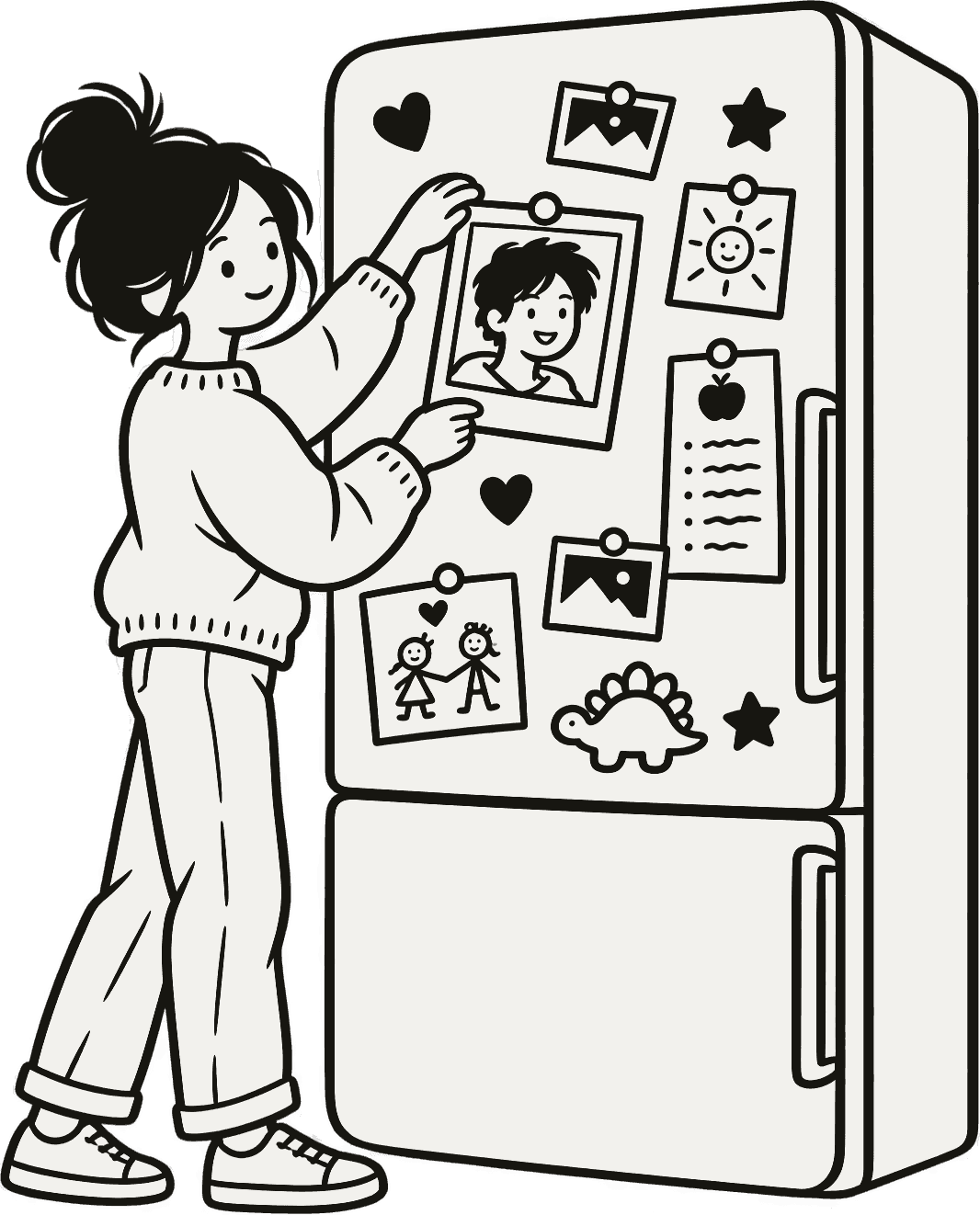
Out of sight, out of mind works in reverse: in sight, in mind. Put the people you’d hate to lose track of where your eyes already go.
Tie it to a when, not a later
Event-based intentions held up better in those earlier studies, so hook friends onto things that already happen: text your sister from the sideline at the kids’ Saturday soccer, or ring your oldest mate on the walk to the shops. Promise “I’ll call when I’m back from Adelaide”, not “I’ll call soon”: the flight home is a cue, and you’ll be on it either way.
For a nudge from your phone, here’s how to set a reminder to call someone on iPhone.
Make every hello ten seconds long
A ten-second hello can go out before you forget. One caveat, from a study of 1,910 Facebook users: getting messages written just for you by a close friend went with better well-being, while getting “one-click feedback” did not.
It was Facebook in 2011, so hold it lightly. Still, a heart on its own is a nod. One typed line turns it into a hello.
Here are nine to borrow, from one tap to two minutes. Tap for another, or open the full list.
Quick hellos, sorted by energy
Forward the meme to them, not the group chat.
Aimed at one person, it’s a hello
All 9 hellos
1 tap
- Forward the meme to them, not the group chat.Aimed at one person, it’s a hello
- Send a photo of the thing that reminded you of them. No caption needed.The dog, the pie, the terrible jumper
- Send the photo your phone just dug up from three years ago today.Your camera roll did the remembering
10 seconds
- This is the most you thing I’ve seen all week.Under any photo, link or meme
- Heart their story, then add one line: “Is that the new place? I’m jealous of that kitchen window.”The line is the part that counts
- Our old bus stop has a new bench. I sat on it on your behalf.Any shared place will do
2 minutes
- You mentioned your mum’s hip op was this month. How’s she recovering?Straight from your notes on them
- I’m getting the car washed on Saturday at 10. Coffee next door while it dries?Hooked onto something already happening
- Still thinking about Dev’s engagement party, when we laughed so hard we had to leave the room. Neither of us remembers why. Coffee on Sunday to work it out?A shared joke is a head start
Keep notes on your friends
“Make notes on your friends”, advises Cynthia Hammer in CHADD’s Attention magazine: their interests, the people who matter to them and what they’re up to. Working memory has better things to do than hold the name of your mate’s daughter’s imaginary horse (Gerald, eats only apples, write it down). Each mate in Howdy Mate! has a Notes box and interests, which is where Gerald and the apples go.
Birthdays and big dates
Hammer also suggests letting a computer program remind you of birthdays and anniversaries. Enter each date once, somewhere that warns you early enough to act.
A reminder on the day is a reminder. A reminder the week before is a plan. Our guide on how to remember friends’ birthdays has three systems that work.
If you’d rather an app did the remembering, here’s our comparison of the best apps to keep in touch with friends.
Is ADHD an excuse for not texting back?
ADHD is an explanation, not a free pass. It can make forgetting genuinely more likely, and the friend on the other end still feels the silence.
Start with the explanation. CHADD calls ADHD an “invisible disability” whose behaviours people often read as rude or lazy, and in a 2022 study of 162 adults with ADHD or high ADHD traits, “behaviours associated with inattention were perceived as the most criticised”.
One participant was told to “just write things down like we do!” Which is, annoyingly, the advice. Just without the tone.
Barkley adds that complaining about someone’s laziness or willpower “will not suffice to correct the problem”. Better cues do more than better intentions.
The other side is just as real. ADHD is only diagnosed when symptoms “interfere with” social, school or work functioning, and as Talkiatry says, “Though you didn’t mean any harm, others may feel neglected.”
So here’s the fair deal: ADHD explains the silence, and you still own the system that ends it. If you’re lying awake wondering what that makes you, our am I a bad friend quiz is a kinder place to start than 2am.
How to explain ADHD to your friends
Tell them early, in a sentence, and move on. Psychologist Ari Tuckman calls this expectation management, “telling them what they should and shouldn’t expect you to do”, and understanding can ease things: the authors of the criticism study suggest that understanding the behaviours of someone with ADHD “encourages more supportive behaviour in place of criticism”.
- Quick heads-up: I have ADHD, so out of sight can mean out of mind for a bit. Same goes for my keys, and I love my keys. If I go quiet, nudge me.
- If you need an answer by a certain day, tell me the day. “Friday” I can remember. “Whenever” I will lose.
- I’ve started keeping notes on the people I love so the details stop slipping. You’re in there. Your cat’s full name has its own line.
Coming back after a long silence needs its own words: see our guide on how to apologise for not texting back.
If your friend with ADHD never replies
If you’re the friend on the other end, it often isn’t a verdict on you. As Hammer writes in CHADD’s Attention magazine, “friends can wrongly believe we are not interested in them and don’t value their friendship.” Say what you need plainly, give a day when you need an answer and call if it’s urgent.
If the friendship is warm whenever you’re together, keep reaching out; you might be the photo on their fridge door. And if it keeps hurting, say so kindly.
The short version
- It’s a nickname. Object permanence isn’t an ADHD diagnosis, but forgetfulness, including returning calls, is in the criteria.
- It isn’t about caring. Trouble remembering to act later, working memory and managing time can all play a part.
- Keep people in sight. Faces where you look every day, notes on friends and birthdays in a system.
- Swap “later” for a when. Tie hellos to things that already happen.
- Make it ten seconds. A photo plus one line counts.
- Tell friends once. What to expect, and how to get a clear answer from you.
This guide isn’t medical advice. If forgetting is getting in the way of your relationships, the NHS suggests you “make an appointment with a GP”, and in Australia you can call healthdirect on 1800 022 222.
Now open the drawer, take one person out and say hello. They were never lost, just somewhere behind the good scissors. They’ll be glad you went looking.
Questions people ask
Is object permanence a symptom of ADHD?
No. Object permanence is a baby development milestone, not an ADHD symptom or diagnosis. People with ADHD use the phrase as shorthand for out of sight, out of mind. The official criteria do include being often forgetful in daily activities, with returning calls given as an adult example.
Do people with ADHD forget to text back?
Often, yes, and it isn’t because they don’t care. A reply is an intention to do something later, and remembering to act on intentions at the right time is harder for many adults with ADHD. Replies that get started and then interrupted are easy to lose too.
Is ADHD an excuse for not texting back?
It’s an explanation, not a free pass. ADHD can make forgetting genuinely more likely, and friends still feel the silence. The fair middle is to explain it once, set up reminders that work for you and tell friends how to get a clear answer when something matters.
How do you maintain friendships when you have ADHD?
Move the remembering out of your head. Keep the people you care about somewhere you look every day, tie contact to events rather than “later”, put birthdays in a reminder system, keep short notes on friends and make each hello small enough to send in ten seconds.
Is not missing people an ADHD thing?
It isn’t a recognised ADHD symptom, and there’s little research on it. Friends not coming to mind while you’re apart isn’t the same as not caring about them. If you’ve lost interest in everyone and everything, most of the day, every day, for more than two weeks, talk to a GP.
My friend with ADHD never replies. What should I do?
It often isn’t a verdict on you, so say what you need plainly. Give a specific day when you need an answer, call if it’s urgent and keep reaching out if the friendship feels good when you’re together. If it keeps hurting, tell them kindly.
Want a hand remembering? Howdy Mate! is free on the App Store.
Sources
- Table 7, DSM-IV to DSM-5 attention-deficit/hyperactivity disorder comparison. Substance Abuse and Mental Health Services Administration, 2016.
- ADHD in the DSM-5-TR: what has changed and what has not. Frontiers in Psychiatry, 2022.
- Understanding object permanence and ADHD. Talkiatry, 2024.
- Cognitive development in infants: 8 to 12 months. American Academy of Pediatrics, HealthyChildren.org, 2023.
- Attention deficit hyperactivity disorder (ADHD). healthdirect Australia, 2025.
- Complex prospective memory in adults with attention deficit hyperactivity disorder. PLoS ONE, 2013.
- Attention-deficit/hyperactivity disorder (ADHD) and working memory in adults: a meta-analytic review. Neuropsychology, 2013.
- The important role of executive functioning and self-regulation in ADHD. Russell A. Barkley.
- Time perception in adult ADHD: findings from a decade, a review. International Journal of Environmental Research and Public Health, 2023.
- Symptoms of depression in adults. NHS, 2023.
- Object permanence and ADHD: definition and tips for coping. Medical News Today, 2026.
- Cognitive behavioral therapy vs relaxation with educational support for medication-treated adults with ADHD and persistent symptoms: a randomized controlled trial. JAMA, 2010.
- Being social and making friends as an adult with ADHD. CHADD, 2025.
- Cognitive assistive technology and professional support in everyday life for adults with ADHD. Disability and Rehabilitation: Assistive Technology, 2013.
- The relationship between Facebook use and well-being depends on communication type and tie strength. Journal of Computer-Mediated Communication, 2016.
- Maintaining friendships. CHADD, Attention magazine, 2022.
- Relationships and social skills. CHADD National Resource Center on ADHD, 2018.
- Experiences of criticism in adults with ADHD: a qualitative study. PLoS ONE, 2022.
- ADHD in adults. NHS, 2025.
Written by Sammy Sergi, who makes Howdy Mate!, a free iPhone app for keeping in touch with the people who matter. Every guide is checked against the research it cites.