
How to check in on a grieving friend: how often, what to say and the dates that matter
How to check in on a friend who is grieving: how often to text, what to say months later, plus a gentle plan for anniversaries and hard dates.
The short of it
- Check in on a grieving friend with short, regular messages that ask for nothing back, and keep going long after the funeral, when support often fades.
- In a UK survey by the charity Sue Ryder, almost a third of bereaved people said friends and family stopped asking how they were after just three weeks.
- Say their person’s name, share small memories and swap “let me know if you need anything” for one specific offer with a day attached.
- Note the anniversary, their person’s birthday and the first Christmas, and get in touch on those days even if your friend rarely replies.
To check in on a friend who is grieving, send short, regular messages that ask for nothing back, say their person’s name, offer one specific kind of help and keep going long after the funeral. Your messages matter most in the weeks and months when many others have gone quiet, and on the dates that will hurt.
If you’re here because you’ve typed “I’m so sorry”, deleted it and typed it again, you’re in good company. Nobody has the perfect words. The lasagne doesn’t either, and it still helps.
Below: what to say, how often to get in touch, a first-year plan you can match to real dates, anniversary messages and what to do if they don’t reply.
How to check in on a friend who is grieving

Start small and start soon. A text is a fine first step: the Victorian Government’s Better Health Channel, in guidance approved by Grief Australia, lists a text alongside a visit, a call, a card or flowers.
And support from friends is no small thing. In a survey of 678 bereaved people in Australia (run in 2013 and 2014, and published in 2018), 88.3% of those who leaned on friends found them very or quite helpful. Everyone was reached through funeral providers, so it isn’t a random sample.
- Say something. Most people are “more likely to notice those who didn’t say anything, than those who did”, says Cruse Bereavement Support.
- Ask for nothing back. Tell them they don’t have to reply. One bereaved person quoted by Cruse valued friends who would “get in touch to offer support, without expecting a reply”.
- Be specific. Griefline warns that asking “can I do anything?” “transfers the decision-making burden to the grieving person.” Name the thing and the day.
- Follow through. In that Australian survey, one bereaved person listed “Offers of assistance that were not followed up” as unhelpful. One lasagne on the doorstep beats any number that were offered.
- Far away counts too. A funeral-day text and a meal ordered to their door both travel well. There’s more in our guide to long-distance friendship.
- Keep going. Support often “starts to fade away after the funeral”, Cruse notes. So write the dates down once, somewhere that will remind you, the same trick as in our guide on how to remember friends’ birthdays.
It turns out there’s a right way to leave a meal, too. Sue Ryder, a UK bereavement charity, suggests choosing a dish “they can freeze for later” and telling them “when you will be coming”.
Not all help is food. One person in the Australian survey singled out friends who “helped to weather-proof the patio for funeral services”. Nobody would think to put that in a sympathy card, and it’s the help they chose to mention.
What to say to a grieving friend (and what not to say)
Say you’re sorry, say their person’s name and say something true and small. Skip anything that explains the death, fixes the feeling or finds a bright side.
Better Health’s advice is to “Use the name of the deceased person in conversation” rather than “he, she or they”. If your friend flinches at it, take your lead from them.
Memories can be tiny: one bereaved person told Cruse what helped was people’s small memories of their mum, right down to “she made me toast”. It doesn’t need to be profound. A memory the size of a slice of toast is plenty.
Try
- Use their person’s name, and keep using it.
- “I’m so sorry about [name].”
- One small memory, if you have one.
- A specific offer, with a day attached.
- Checking in again next week.
Skip
- “Everything happens for a reason.”
- “I know exactly how you feel.”
- “At least they had a long, happy life.”
- “Let me know if you need anything.”
- Going quiet once the funeral is over.
The first two skips are on Better Health’s list of comments to avoid. Cruse swaps the third for “I’d love to hear more about their life”, and “You know where I am if you need me” for “I’ll call Thursday at 7pm, answer if you feel like talking, or I’ll try again next week.”
It’s the least poetic sentence in this guide, and possibly the most useful.
Comfort in, dump out
Clinical psychologist Susan Silk’s ring theory, set out with Barry Goldman in a 2013 Los Angeles Times piece, puts the person at the heart of a crisis in the centre ring and everyone else in rings further out. Comfort goes in; complaints go out, to someone in a bigger ring.
It’s an opinion piece with illness examples, but it fits grief: if this loss has knocked you around too, vent outwards, to your partner, your sister or a very patient dog. The piece’s own list of good things to say includes “Can I bring you a pot roast?”
How to check in on a friend who lost a parent
Losing a parent as an adult is common, and common isn’t the same as small. A large US study of adults (its data dates from 1987 to 1993) concluded that researchers and practitioners “should not underestimate the impact” of a parent’s death on adults’ wellbeing.
Mother’s Day and Father’s Day (May and September in Australia) are on Cruse’s list of hard firsts, as are milestones their parent misses. As one person told Cruse, “When I had a child of my own, the grief hit me all over again.”
How often should you check in on a grieving friend?
More often than usual at first, then less often, but never stopping. There’s no research-backed schedule, so start by asking: Griefline suggests checking whether they’d like you to “call or text or drop-in”, and whether “daily, every couple of days, or weekly” suits them. It’s a slightly awkward question to send, and far less awkward than a month of guessing.
3 weeks
That’s from a Sue Ryder survey of 1,061 bereaved people in the UK in late 2019, a charity poll rather than peer-reviewed research. In the same survey, close to two thirds said the idea that grief has an end point was “simply untrue”.
Grief doesn’t end at the funeral, so neither should the texts.
If your friend would rather you just decide, here’s a rhythm that errs on the side of showing up. It’s our suggestion rather than anything official, and a step up from how often to talk to friends in ordinary times. (A schedule for kindness sounds clinical, but the texts won’t be.)
- The first fortnight: every day or two, briefly.
- Weeks three to twelve: about once a week.
- Months three to twelve: every two to four weeks, plus the hard dates.
- After that: the hard dates, and whenever they cross your mind. Sue Ryder says checking in “a year or two after a death can be just as important as in the first few weeks.”
What to text a grieving friend weeks, months and a year later
The texts don’t need to change much: short, warm and with their person’s name in them. What changes is how many other people are still sending them.
The plan below follows Sue Ryder’s guidance, which warns that grief can bring “intense sadness out of the blue” as someone starts to feel better, and Cruse, which notes that “some people find the second year even harder.”
A gentle check-in plan for the first year
Pick a date to see real dates against the day their person died. The date never leaves this page.
The first few days
Say something, even if it’s short. A text is fine; call if you’re close.
- I’m so sorry about [name]. I’m thinking of you. You don’t need to reply to this.
Week one
The funeral may be this week or a few weeks away. If you can’t be there, text on the day. Make one practical offer with a day attached, then do it.
- I can’t be there on Friday, but I’ll be thinking of you and [name] all day.
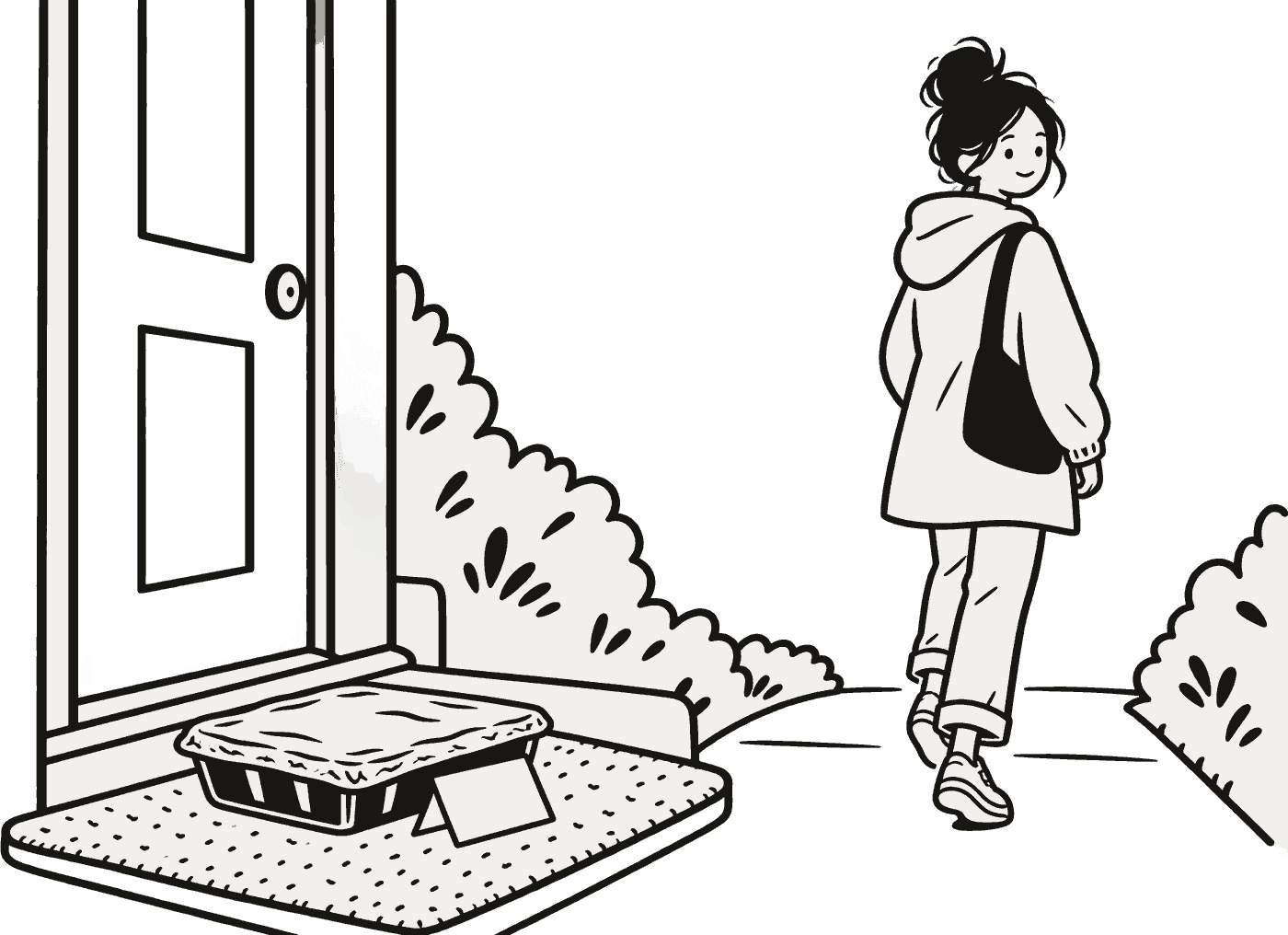
- I’m dropping a lasagne round on Wednesday evening. It freezes, and the tray doesn’t need to come back. I’ll leave it on the doorstep and won’t knock, unless you’d like me to.
Week three: when many people stop asking
For many bereaved people, the messages start drying up about now. Keep yours coming.
- Still thinking about you and [name]. How has this week been? Only answer if you feel like it.
Week six
Life around them has moved on, and they may not have. Invite them to something you’re doing anyway, with an easy way out.
- I’m walking along the river on Sunday morning. Come if you’d like company, and if not, I’ll ask again another week.
Month three
Grief can come back hard just as others expect it to ease. Saying their person’s name tells your friend nobody has forgotten.
- Walked past [name]’s favourite [café] today and thought of them. Hope today is a gentle one.
Month six
The firsts land somewhere in year one: their person’s birthday, Mother’s or Father’s Day, Christmas. Ask ahead how they’d like each one handled.
- [Name]’s birthday is next month. Would you like company that day, or an ordinary day? Either is completely fine.
One year
The first anniversary. Get in touch on the day, even if you’re unsure it’s welcome. Some find the second year harder still, so keep the date for next year too.
- A year today. I’m remembering [name] with you, especially [one small thing you loved about them]. Don’t feel you have to write back.
In Howdy Mate! these dates belong on your friend’s page, never on a page for the person who died. As well as the anniversary and their person’s birthday, you can add week three, week six and month three as important dates, with “Repeats every year” switched off so each shows up once.
One caution: if their person is still in your Contacts, leave them unticked when you add people. Otherwise the app will add them as a mate and, if their contact card has a birthday, send you birthday reminders for them.
What to text on the anniversary of a death (and other hard days)
Get in touch on the day, name the person who died and keep it short. Being remembered on a hard day can sting and comfort at once.
In a small German study of relatives sent a card a year after a death, 22 of the 24 who replied (out of 68 asked) said they were pleased to get it. The cards came from hospital staff, not friends, but as the authors put it, “being reminded can be simultaneously painful and consoling.”
Cruse’s list of dates that tend to hurt is longer than most people expect:
- The anniversary of the death, and of the days before it, such as a diagnosis or going into hospital.
- Birthdays: their person’s, your friend’s own and other close family members’.
- Mother’s Day, Father’s Day and wedding anniversaries, plus Christmas and the summer holidays, which in Australia are the same stretch.
When one is coming up, Sue Ryder suggests asking “in advance how they would like you to support them”: some want an ordinary day, some want company.
What to say to a grieving friend at Christmas (and in January)
For the first Christmas, Sue Ryder’s advice is to invite them anyway, make it clear they can say no or stay briefly and, if they’re not up to visitors, “leave it outside with a note”. A foil tray with a note on the step is still being there.
Then keep going into the new year. In a 2023 Censuswide survey for Sue Ryder of 1,000 bereaved people in the UK, 61% agreed January is one of the most challenging months to grieve, most often because of “the sadness of beginning another year” without the person who died.
- Thinking of you on [name]’s birthday. I’d love to hear a favourite story about them, whenever you feel like telling it.
- I know Sunday might be a hard one without your mum. I’m thinking of you, and of [her name]. I’m free all day if you’d like company.
- I’ll be thinking of you and [name] on Christmas Day. If it all gets too much, I’m a phone call away, at any hour.
- Two years today, and I’m still thinking of [name]. Sending you love, whatever kind of day it turns out to be.
What if your grieving friend doesn’t reply?
If your grieving friend is not responding, keep going, and don’t read the silence as a verdict. Sue Ryder notes that a grieving friend may say yes to an offer, say no or “not be ready to respond at all yet.”

Grief researchers Margaret Stroebe and Henk Schut describe coping with bereavement as a process of “oscillation”: a grieving person “at times confronts, at other times avoids, the different tasks of grieving”, and taking “respite” is part of coping well. A quiet week may simply be a rest.
So lower the ask, not the contact: statements instead of questions, a note of when you’ll try again, invitations to things you’re doing anyway. People “may turn down or cancel invitations, but still appreciate being asked”, Sue Ryder says.
- No news here, just sending love. I’ll try you again next week.
- Leaving soup on your doorstep tomorrow around 6. I won’t knock.
You’ll be tempted to reread your last message for typos, tone and proof you’ve made things worse. You almost certainly haven’t. Send the next one next week.
If a reply comes back sharp, Cruse notes grief’s strong emotions can land on people who mean well: apologise if needed, and carry on. Went quiet at the start? It’s rarely too late, and our guide on what to text a friend you haven’t talked to has a message for exactly that.
If you’re worried about them
Most grieving people don’t need professional help; with support from family and friends, Better Health notes, they gradually find “ways to learn to live with their loss”. If, over time, they seem to be struggling with day-to-day life, gently suggest a GP.
In Australia, Griefline (now part of SANE Australia) is on 1300 845 745, weekdays 10am to 8pm AEST/AEDT except public holidays. Calls now go to SANE’s support team, who can point your friend to grief support.
Lifeline is on 13 11 14, or text 0477 13 11 14, any time of day or night. If someone is in immediate danger, call 000.
Elsewhere: in the UK, Cruse’s helpline is 0808 808 1677 (weekdays, hours vary) and Samaritans are on 116 123 at any hour (in Ireland too). In the US, call or text the 988 Lifeline; in Canada, 9-8-8; in New Zealand, 1737, all at any hour. We checked these numbers in September 2026.
The short version
- Start now. A short text is fine. Use their person’s name, and ask for nothing back.
- Be specific. Offer one thing, on one day, then do it.
- Keep going. Every day or two at first, weekly until about month three, then every few weeks.
- Mark the hard dates. The anniversary, their person’s birthday, Mother’s or Father’s Day and the first Christmas.
- Don’t read the silence. Lower the ask, and send the next one anyway.
You won’t find the perfect words, and neither will anyone else. Send the text, leave the lasagne on the step and still be there in week six. That’s the part people remember.
Questions people ask
How often should you check in on a grieving friend?
More often than usual at first, then less often without ever stopping. There’s no research-backed schedule; our suggestion is every day or two for the first fortnight, weekly until about three months, then every few weeks plus the hard dates. Better still, ask them how often they’d like to hear from you.
What do you text a friend who is grieving?
Something short and personal that asks for nothing back, such as “I’m so sorry about [name]. I’m thinking of you, and you don’t need to reply.” Use the name of the person who died, and add one specific offer, like dropping off a meal on a named day.
What do you say to a grieving friend at Christmas?
Say you are thinking of them and name the person who died, such as “Thinking of you and [name] this Christmas.” Invite them anyway, with an easy way out: Sue Ryder suggests making clear they can say no or stay briefly and, if they are not up to visitors, leaving something outside with a note.
What if my grieving friend is not responding?
Keep sending short messages that don’t need an answer, and don’t read the silence as rejection. Grieving people may not be ready to respond for a while. Make statements rather than questions, say when you will try again and keep going.
Should I give my grieving friend space?
Give them space from pressure, not from you. Keep contact light and reply-optional, invite them to things with an easy way out and ask how they would like you to stay in touch. Don’t go quiet and wait for them to reach out.
What should I text on the anniversary of a death?
Send a short message on the day that names the person who died and says you are thinking of your friend, such as “Thinking of you and [name] today.” Add one small memory if you have one, and make it clear they don’t need to reply.
Sources
- Sue Ryder survey reveals almost half of people experience poor mental health following the death of a loved one. Sue Ryder, 2020.
- Grief: how to support the bereaved. Better Health Channel, Victorian Government, 2022.
- What sources of bereavement support are perceived helpful by bereaved people and why? Empirical evidence for the compassionate communities approach. Palliative Medicine, 2018.
- What to say when someone is grieving. Cruse Bereavement Support, 2025.
- Helping someone as time passes. Cruse Bereavement Support, 2025.
- Supporting a grieving friend: ways to help someone who is grieving. Griefline, 2021.
- The support bereaved people say is most helpful. Sue Ryder, 2024.
- How not to say the wrong thing. Los Angeles Times, 2013.
- Death of parents and adult psychological and physical well-being: a prospective U.S. national study. Journal of Family Issues, 2007.
- How can you support someone who is grieving?. Sue Ryder, 2024.
- Family members of deceased palliative care patients receiving bereavement anniversary cards: a survey on the recipient’s reactions and opinions. BMC Palliative Care, 2017.
- Supporting your loved one through grief at Christmas. Sue Ryder, 2024.
- Sue Ryder braces for unprecedented demand for services this January. Sue Ryder, 2024.
- The dual process model of coping with bereavement: rationale and description. Death Studies, 1999.
- Griefline helpline: nationwide telephone support. Griefline, part of SANE Australia, 2026.
- 13 11 14 crisis support. Lifeline Australia, 2026.
- Helpline. Cruse Bereavement Support, 2026.
- Contact a Samaritan. Samaritans, 2026.
- 988 Suicide & Crisis Lifeline. 988 Lifeline, 2026.
- 9-8-8: Suicide Crisis Helpline. 9-8-8 Canada, 2026.
- Where to get support. Te Hiringa Mahara, Mental Health and Wellbeing Commission, 2026.

Written by Sammy Sergi, who makes Howdy Mate!, a free iPhone app for keeping in touch with the people who matter. Every guide is checked against the research it cites.