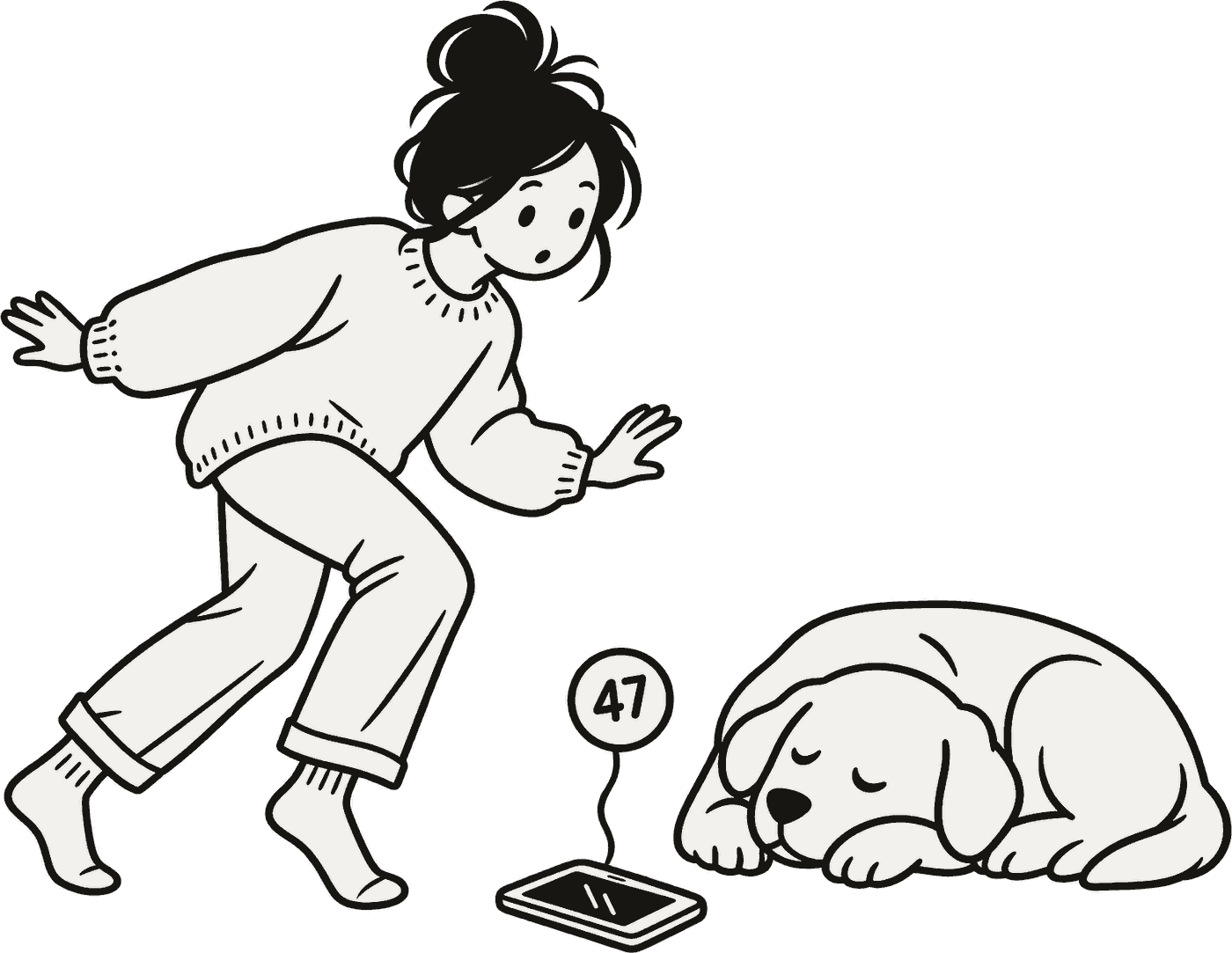
How to apologise for not texting back (without grovelling), from a day late to a year
How to apologise for not texting back or responding to a text: what to say by how late you are, what works and what to do if they reply coldly.

The short of it
- Answer their message first, own the delay in one short line and suggest a plan with a day in it, keeping the sorry shorter as the gap gets longer.
- In an Ohio State study of 755 people rating apologies, acknowledging responsibility mattered most and an offer of repair came second, while asking for forgiveness mattered least.
- Skip “I’ve been so busy” and invented stories: one apology study files “I was very busy and in a hurry” under excuses, and people mind finding out a reason was made up.
- If the message you missed was about something serious, reply today, lead with their news and check in again a couple of weeks later.
Here’s how to apologise for not texting back: answer their message first, own the delay in one short line, then suggest something specific, like a call or a coffee on a named day. Skip the excuses and the life story. The longer the gap, the shorter the apology, because the reply itself is doing most of the apologising.
A 400-word apology for a three-week-late reply isn’t an apology. It’s a hostage statement, and the only way your friend can secure your release is to write back “honestly, no stress!”
Meanwhile, Luca’s text from three weeks ago (“how did the interview go??”) is still sitting there, now a genuine cliffhanger. Below: what the research says works, an excuse tier list and a builder that sizes your sorry to the gap.
If there’s no unanswered message, just a long quiet patch, start with our guide on how to reconnect with an old friend instead.
How to apologise for not texting back (or responding to a text)
A good late reply does three things, in this order.
- Answer what they sent. They asked a question, shared news or invited you somewhere. Lead with that, so your text is useful before it’s sorry.
- Own the delay in one line. “That’s on me” does more work than any amount of backstory.
- Offer a plan. A call, a coffee, a day of the week. This is the part that turns sorry into something.
- I got it! I start next month. Sorry for the three-week cliffhanger, that’s on me. Yum cha on Saturday to celebrate? My shout.
In two experiments with 755 people, Ohio State researchers found that the most important part of an apology was an acknowledgement of responsibility, followed by an offer of repair. The best-rated apologies had all six elements they tested, but Ohio State’s write-up of the study says that if you’re “pressed for time or space”, those two matter most. A text is about as pressed for space as it gets.
A request for forgiveness came last: “That’s the one you can leave out if you have to,” said lead author Roy Lewicki. The people doing the rating were judging a job candidate who had “filed an incorrect tax return that understated a client’s capital gains income”. Your three weeks of silence is, whatever else it is, not a tax matter.
The plan matters more than it looks. In lab studies with strangers, people who imagined getting an apology valued it far more than people who actually got one, and the authors concluded that “an apology alone will not achieve the desired result.” So, like the ghost at the top of this page, turn up with something in your hands.
The excuse tier list
The usual reasons, ranked:
- S tier: “That one’s on me. Tacos on Friday, my shout?” Responsibility and repair, the two heaviest elements in the Ohio State research, in nine words.
- A tier: the honest reason, minus the blame. “I went quiet because I was overwhelmed, and that’s on me.” In a 2014 study that coded people’s apologies, explaining what happened without pinning it on outside forces counts as part of a real apology.
- B tier: “Sorry for the slow reply.” Harmless, and fine for a day or two. It just won’t be anyone’s favourite text of the year.
- C tier: “Sorry, I’ve been SO busy.” The same study’s textbook example of an excuse, meaning an attempt to shrink your responsibility, is “I was very busy and in a hurry”. Being busy is real. It just isn’t news.
- D tier: “Sorry if that upset you.” The study lists “I’m sorry if I upset you” as a minimisation, in the same list as “it was just a joke”. The word doing the damage is “if”.
- E tier: the elaborate story. The phone that fell in the harbour, the cousin’s wedding with no reception. If it comes out, people mind: in a Michigan State study about cancelling plans, more than 80% said they’d be annoyed to find out a friend’s excuse was a lie.
- F tier: “Sorry, just seeing this.” Sent beneath a message that has said “Read” since the long weekend. With read receipts on, the sender sees the word “Read” below their message, so this excuse arrives with the evidence attached.
Should you apologise for replying late?
Not always. It mostly depends on what they sent:
- A meme, a photo, a thumbs-up. No apology needed. Good memes keep.
- A question or a plan. Answer it, own the wait in a line and offer a new date if the old one has passed.
- News, good or bad. Their news first, your sorry second.
- Something heavy. Reply today, and read responding late to a text about something serious first.
How soon a slow reply starts to feel like being ignored depends more on the situation than on how close you are. In a 2025 study of when waiting turns into feeling ignored, patience ran out sooner for urgent messages and with people who usually reply quickly, but closeness didn’t predict it. That’s why Luca’s “how did the interview go??” was always on a shorter fuse than a meme.

For short delays, you can swap sorry for thanks. In research on service failures, such as a plumber turning up late, “Thank you for your patience” often beat “I am sorry for the wait”, mainly among more narcissistic customers. Your friends aren’t customers and you aren’t a plumber, so save “thanks for waiting on me” for small waits.
Either way, the apology is usually smaller than the dread. In a series of studies, people who had wronged someone expected apologising to feel worse than it actually did, even when it was typed, and underestimated the good it would do. The dread has just had three weeks to rehearse.
Other people are gentler judges than we expect, too: in a classic set of studies on social blunders, people who imagined setting off a library alarm or being the only dinner guest without a gift expected to be judged more harshly than they were.
The third blunder was being seen carrying a K-Mart bag. Australian readers may need a moment to find the problem.
If slow replies are your default rather than a one-off, our guide for anyone bad at texting back has a plan.
What to say when you forgot to text someone back (a day, a month, a year)
As the gap grows, shrink the sorry and grow the plan. Call it the inverse apology law (our rule; no lab has tested it): a day late gets a sentence, a month late gets a line and a year late gets five words and a table for two.
After a long silence, three paragraphs of sorry is the hostage statement again, now with footnotes. A short sorry and a coffee invitation ask them for one decision instead.
- A day or two. Answer, add “sorry for the slow reply” if you like and carry on.
- A week or a month. The answer, one line of ownership and a new day if the old plan has passed.
- Six months. The message is history; the friendship isn’t. Own it briefly and invite them somewhere specific.
- A year or more. Keep the sorry tiny and the invitation real. This is a reconnection with an apology attached, so borrow an opener from what to text a friend you haven’t talked to.
Try it, and watch the sorry shrink while the plan grows.
Size your sorry to the gap
Swap in your real answer when you paste it.
Pick the line for how late you are. They get shorter.
Yes to dinner, if the offer’s still open! Sorry for the slow reply, yesterday got away from me. Still on for Friday?
22 words
Every option
Offer a plan
When Own it is “Sorry for the slow reply, yesterday got away from me.”
- Still on for Friday?
- Call you tonight for the full story?
When Own it is “Sorry for going quiet all week, that’s on me.”
- Coffee this week? I’ll get there first, for once.
- Can I ring you on Sunday night and hear everything?
When Own it is “A month of silence. I dropped the ball.”
- Pizza on Thursday? I’ll bring garlic bread and my full attention.
- Could we get a walk in this weekend? Saturday or Sunday morning?
When Own it is “Six months late, I know. I’m sorry.”
- Dinner next week, Tuesday or Wednesday? You pick the place and I’ll get the bill.
- Could I ring you this weekend? I’d really like to hear how you are.
When Own it is “A whole year. I’m sorry.”
- I’d really like to see you. Could I buy you a coffee this month? Pick the day and the place, and I’ll be there.
- If you’re up for it, I’d love to hear how your year has been. Can I call you on Sunday?
Choose those few words well. In a small UK study of apology wording, apologies with longer words (“genuinely” rather than “really”) read as more apologetic. Longer words, note, not longer messages.
So “A whole year. I’m genuinely sorry.” is, scientifically speaking, the deluxe model.
Say sorry once, then say when.
If it was their birthday
Missed their birthday and their message? Same rules: happy birthday first, sorry second, cake third. Our guide to belated birthday messages for a friend has the wording.
How to apologise to a friend you ghosted (even by accident)
Say that you went quiet, say it’s on you and offer a way back, without inventing a reason or asking them to forgive you on the spot. Then let them set the pace.
In a 2026 study of ghosting across twelve countries, the researchers define ghosting as “ending a relationship by cutting off contact”, which is a decision. Plenty of people searching this never made one. They meant to reply on a Tuesday, and the Tuesday quietly turned into a season.
So say what happened: “I didn’t mean to disappear, and I’m sorry I did.” It’s honest, and it answers the question they may be quietly asking: was it me?
If awkwardness kept you away, that’s one of the most common reasons. In interviews with 34 undergraduates who had ghosted someone, avoiding confrontation came up as a theme. The message only gets heavier, so send it this week.
Do
- Say you went quiet, in so many words.
- Give the honest reason in one sentence, if there is one.
- Offer something specific, then let them set the pace.
Don’t
- Write three paragraphs about the state of your inbox.
- Blame being SO busy. See C tier.
- Ask for absolution before they’ve finished reading.
- I went quiet on you for most of this year, and I’m sorry. It wasn’t anything you did. Coffee soon? I’d love to hear how you are.
- Your message has survived two software updates and deserved better than this. No good excuse: I let it slide, then felt too awkward to fix it. I miss you. Dinner soon?
- Hi Mel. I disappeared on you and I’m sorry. Things got hard and I shut everyone out, which wasn’t fair on you. A walk soon, whenever suits?
If a falling-out sits behind the silence, read our guide to reconnecting after a falling-out. And if you’re lying awake wondering what this says about you, our kind am I a bad friend quiz is gentler than the voice in your head.
Responding late to a text about something serious
If the message you missed was about something hard, like a death, a diagnosis, a break-up or losing a job, reply today, however late it is. Lead with what they told you, keep the apology to one sentence and offer something specific. Skip the story of where you’ve been.
- I’m so sorry about the diagnosis, and sorry I didn’t write back sooner. Can I call you tomorrow night, or would a walk on the weekend be better?
- I’m so sorry about you and Alex. I should have replied straight away. I’m free Thursday night if you’d like company, or I can ring you instead.
Then check in again. R U OK? suggests you “Pop a reminder in your diary to call them in a couple of weeks”, and follow up sooner if they’re really struggling.
If their message said they weren’t coping or weren’t safe, help them reach support now. If a life is in danger, call your local emergency number, which is Triple Zero (000) in Australia.
In Australia, Lifeline is on 13 11 14 (or text 0477 13 11 14). In the US, call or text the 988 Lifeline on 988, and in the UK and Ireland, Samaritans are on 116 123.
If they’ve lost someone, our guide on how to check in on a grieving friend covers what to say now and in the months after.
What if they don’t reply to your apology, or reply coldly?
Give them room, and don’t apologise again. A frosty reply is allowed. What helps now is being reliable, not sorrier.
If they reply warmly, lovely: book the plan you offered, because that was the repair. If you use Howdy Mate!, log your reply as a check-in and jot what they told you in its note, so next time you can open with “How did the move go?” instead of another sorry.
If the reply is a bit short, let it be short. A second apology, or an “are we okay?”, turns their mild annoyance into your emergency and hands it back to them to solve.
The sting usually fades. In a study that followed 73 students for five weeks after someone had hurt them, the urge to avoid that person dropped over time, and those were real hurts, not slow texts. Warmth didn’t automatically return, which is where you come in: react to their next story and turn up to the plan.
No reply at all? Before you read anything into it, remember that you are, as of this week, one of the world’s leading experts on how long a reply can take. Give it time, send one message about their life rather than the silence and leave the door open.
How to apologise for not texting back: the short version
- Answer first. Reply to what they actually sent.
- Own it in one line. “That’s on me” beats a paragraph about your week.
- Offer a plan. A day and a place. That’s the repair.
- Longer gap, shorter sorry. And a bigger plan to match.
- Skip C tier and below. No “SO busy”, no “sorry if”, no invented stories.
- Serious news comes first. Reply today, and check in again later.
Luca is still waiting to hear about the interview. Tell him, say sorry once and suggest the yum cha. He won’t be counting the weeks, just glad to find out how it ends.
Questions people ask
Should you apologise for replying late?
Only if the delay mattered. For a day or two on a casual message, just reply. If they asked a question, made a plan or shared news, answer them first, add one short line owning the wait and suggest something specific.
What do you say when you forgot to text someone back?
Answer what they sent, own the delay in one line and suggest a plan with a day in it. For example: “Yes to dinner, if the offer’s still open. Sorry for the silence, that’s on me. Thursday or Friday?”
How do you apologise to a friend you ghosted?
Say plainly that you went quiet and that it’s on you. Give the honest reason in a sentence if there is one, and offer something specific. Skip invented excuses, don’t press them to forgive you and let them set the pace.
What can I say instead of “sorry for the late reply”?
Try “thanks for waiting on me” or “thanks for your patience”. One study of service failures, like a plumber running late, found thanks often worked better than sorry. With friends it suits a short wait; for a long silence, own it properly instead.
What should you say when someone apologises for not texting back?
Keep it light and pick the conversation back up: thank them, answer what they said and ask about their life. “Great to hear from you. How did the move go?” works well. If the silence genuinely hurt, you can say so kindly later.
Want a hand remembering? Howdy Mate! is free on the App Store.
Sources
- The 6 elements of an effective apology, according to science. Ohio State News, 2016.
- How important is an apology to you? Forecasting errors in evaluating the value of apologies. Psychological Science, 2011.
- An affirmed self and a better apology: the effect of self-affirmation on transgressors’ responses to victims. Journal of Experimental Social Psychology, 2014.
- How to cancel plans with friends: a mixed methods study of strategy and experience. Collabra: Psychology, 2023.
- Turn read receipts on or off in Messages on iPhone. Apple Support, 2026.
- When does waiting for a reply turn into ghosting? Individual, relational, and situational predictors of feeling ignored in online messaging. Computers in Human Behavior, 2025.
- Why you should say “thank you” and not “sorry” after most service failures. American Marketing Association, 2020.
- Forecasting errors in the averseness of apologizing. Social Justice Research, 2014.
- Do others judge us as harshly as we think? Overestimating the impact of our failures, shortcomings, and mishaps. Journal of Personality and Social Psychology, 2001.
- Sorries seem to have the harder words. British Journal of Psychology, 2025.
- A cross-national comparison of ghosting knowledge, attitudes, intentions, and behaviors in friendships and romantic relationships spanning twelve countries. Journal of Social and Personal Relationships, 2026.
- When silence speaks louder than words: exploring the experiences and attitudes of ghosters. Personal Relationships, 2023.
- How to ask R U OK?. R U OK?, 2026.
- Lifeline Australia: 13 11 14. Lifeline Australia, 2026.
- 988 Lifeline. 988 Suicide and Crisis Lifeline, 2026.
- Contact a Samaritan. Samaritans, 2026.
- Forgiveness, forbearance, and time: the temporal unfolding of transgression-related interpersonal motivations. Journal of Personality and Social Psychology, 2003.

Written by Sammy Sergi, who makes Howdy Mate!, a free iPhone app for keeping in touch with the people who matter. Every guide is checked against the research it cites.