
How many hours does it take to make a friend? The 50/90/200 study, with a calculator
How many hours does it take to make a friend? Jeffrey Hall’s 50/90/200-hour study in plain English, what counts as time together and a calculator.
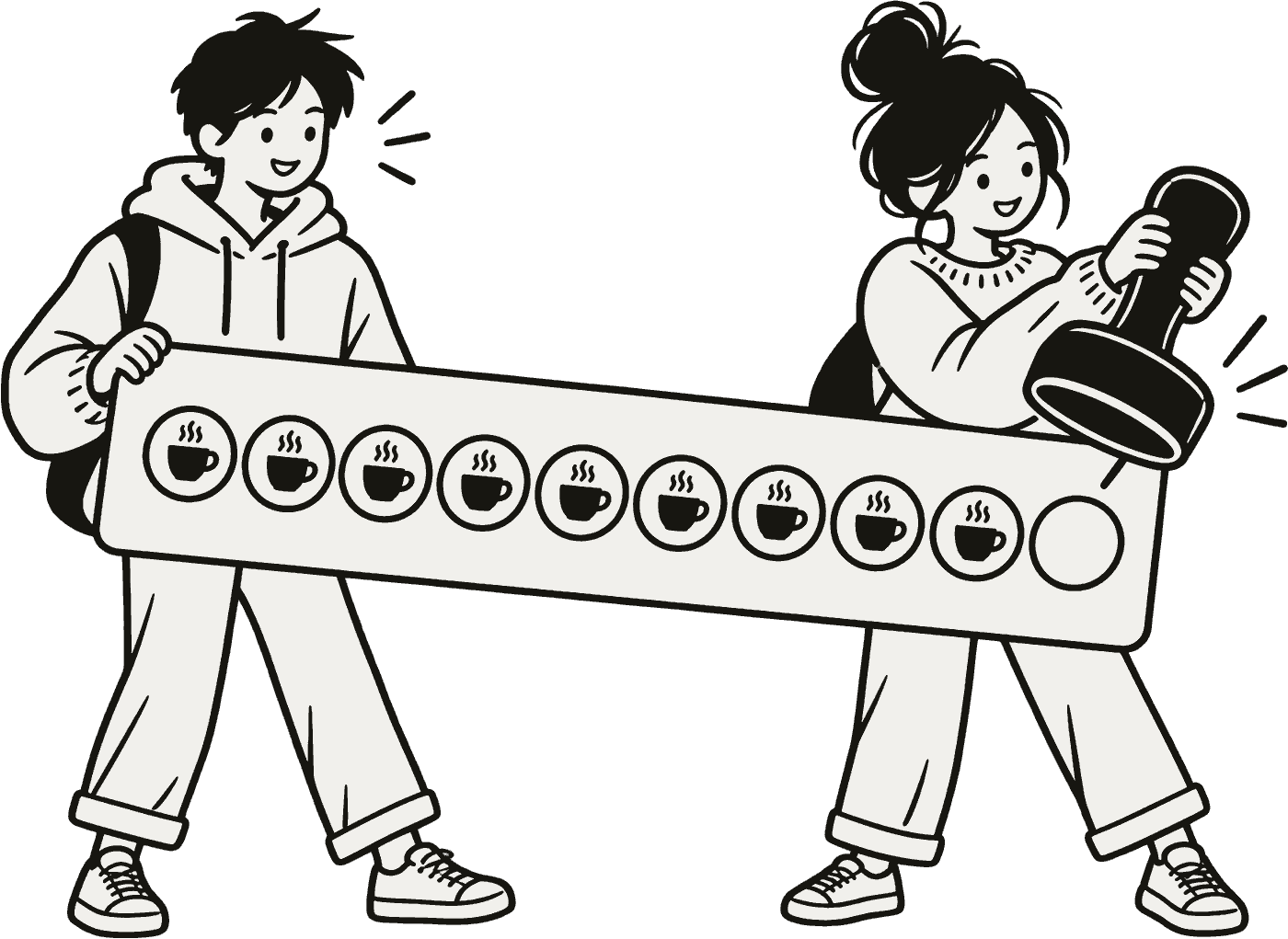
How many hours does it take to make a friend? Research by Jeffrey Hall at the University of Kansas suggests it takes roughly 50 hours together to go from acquaintance to casual friend, about 90 hours to become friends and more than 200 hours to become close friends. The hours are a running total from the day you meet.
Think of it as a coffee loyalty card with about 200 squares, except the free thing at the end is a person who’ll help you move a couch. Hanging out, meals and games earn stamps fastest. Hours spent working side by side earn fewer, which is how you can sit next to someone for three years and still only know them as “Chris from Accounts”.
Calculator: when will you be close friends?
Slide it to roughly how many hours a week you spend with someone new, counting time actually together or talking.
Your loyalty card: how long until it’s full?
At 3 hours a week, that’s about 17 weeks to casual friend, 30 weeks to friend, 67 weeks to close friend.
- Casual friend50 hoursabout 17 weeks (4 months)
- Friend90 hoursabout 30 weeks (7 months)
- Close friend200+ hoursabout 67 weeks (16 months)
Hall’s research puts the tipping points at about 50 hours together for a casual friend, 90 hours for a friend, and more than 200 hours for a close friend.
Jeffrey A. Hall, “How many hours does it take to make a friend?”, Journal of Social and Personal Relationships, 2019. doi.org/10.1177/0265407518761225
The slider stops at 20 hours a week. Past that you’re not so much making a friend as sharing a bathroom.
Three worked examples:
- A coffee every fortnight. An hour every two weeks is the slider’s lowest setting, and it gets you to casual friend in about two years and close friend in nearly eight, by which time the café will have changed owners twice and started doing sourdough.
- Weekly social sport. Two and a half hours every Wednesday, counting the chips after: casual friends in about 20 weeks and close friends in about 80, or a year and a half of relitigating the same bad call from the first game.
- Hall’s first-year students. They reported about 19 hours in a typical week with each new person, on average, which puts 200 hours at around week 11.
The calculator does the arithmetic, but real friendships don’t bank hours at a steady rate. Hall found that after about three months, acquaintances might keep clocking up hours, “but this time does not appear to increase the chance of becoming casual friends”. If your answer comes back in years, take it as a sign to book the next coffee sooner.
How many hours to make a friend? Jeffrey Hall’s study in plain English
Combining two studies, Hall estimated 40 to 60 hours for a casual friendship, 80 to 100 to become friends and more than 200 to become good friends, which is where the famous 50, 90 and 200 come from.
- Study one: 355 adults who had just moved. Americans who had moved at least 50 miles (about 80 km) in the past six months each looked back on one new person they’d met. They were paid 65 US cents apiece.
- Study two: 112 first-year students. Students who had just moved to the University of Kansas answered questions about two new people in weeks three, six and nine of semester.
The detail many write-ups miss: the hours are cumulative, counted from the day people met (Hall’s table notes that the “mean hours reported are cumulative across wave”). So a close friendship is about 200 hours in all, not 50 plus 90 plus 200. That’s 140 hours back, the best part of a month of full-time work, refunded by the small print.
How many hours to make a close friend, or a best friend?
Hall’s top category was a single “good/best friend” bucket, which is why careful summaries say “close friend” rather than “best friend”. In his adult data, best friendships didn’t show up until after about 300 hours together, so a best friend is a close friend who kept turning up.
Why 200 hours feels like so much
School and uni handed out hours for free, five days a week. Adult life makes you book them, then move them, then book them again, which is a big part of why it’s so hard to make friends as an adult.
35 minutes
In Australia, on the day they filled in their 2024 time-use diary, about a quarter of men and three in ten women (aged 15 and over) listed talking or socialising in person among their free-time activities.
Meanwhile, the American survey found people watched 2.6 hours of TV a day. At that rate the telly crosses the 200-hour close-friend line around mid-March, every year, and it has yet to ask how you are.
What counts as time together (and does work count?)
Time you choose to spend together counts most. In Hall’s adult study, a bigger share of time spent hanging out, watching TV and films or gaming together went with closer friendships, while a bigger share at work or school went with less closeness.
How long you’ve known someone isn’t the measure either. As Hall puts it, “it is possible to know someone for years, but not develop a friendship”. Hence the neighbour you’ve waved to every morning since 2019, whose name it is now far too late to ask.
Does time at work count towards making friends?
It counts, just for less. Hall’s survey asked for the hours people were “actually in their company or communicating with them”, adding: “(So, not just you were working the same shift.)” That bracket is the whole work-friend problem in nine words.
Nothing in the study says work hours count half, either. Hall’s fix, from the university’s release: “If you work together, go to lunch or out for a drink.” Chris from Accounts may well say yes, and graduate to just “Chris”.
Which conversations move a friendship along?
The kind of talk mattered more than the amount. In the student study, catching up and joking around predicted friendships getting closer “above and beyond the number of hours together”, while small talk (pets, sports, TV) predicted them getting less close between weeks six and nine.

So “Watched or read anything good lately?” is a fine way in and a thin diet. Howdy Mate! has it in its light set of questions, so yes, we put small talk behind a shuffle button. “What’s something you’ve changed your mind about lately?”, from the deeper set, is much better value.
Texting is a grey area: Hall counted time “communicating with them” without measuring texts separately. So the long thread arguing about the best laksa in town probably counts for something. The laksa itself definitely does.
Four claims about the hours, checked against the research:
Myth or fact: the 200-hour rule, checked
A day at the next desk counts the same as a day at the beach.
Myth
In Hall’s adult study, a bigger share of time at work or school went with less closeness. Work hours count, just for less.
Hall, Journal of Social and Personal RelationshipsTexting counts towards the 200 hours.
Sort of
Hall’s hours included time “communicating with them”, but texting was never measured on its own. A later Hall study found face-to-face talk was more closely tied to how people felt that day.
University of Kansas, 2023Keen? You can cram all 200 hours into one big week.
Sort of
Not into one week, which only has 168 hours, sleep included. But students who became close friends did cram, some spending a third of their waking hours in a month with one person, and Hall puts it at 200-plus hours over about six weeks. It takes two, though.
Hall, Journal of Social and Personal RelationshipsIt takes 200 hours to become best friends.
Sort of
Hall’s top category lumped good and best friends together. In his adult data, best friendships didn’t show up until after about 300 hours.
Hall, Journal of Social and Personal Relationships50, 100 or 200 hours to make a friend? Why the numbers differ
Because the paper has three sets of numbers, and every headline picked its favourite:
- 94, 164 and 219 hours. From the adults who had moved: the points where the next level became more likely than not, from people looking back on friendships about three months old.
- 43, 57 and 119 hours. From the students, about three weeks after meeting. Nearly half had met in the dorms, where the architecture did most of the work.
- 50, 90 and 200-plus hours. The university’s rounding of Hall’s combined estimates, which the paper gives as ranges of 40 to 60, 80 to 100 and more than 200.
Hall thinks the adult figures run high (“likely conservative”, in his words), partly because people kept adding hours after a friendship had already moved up a level. He also wonders, without claiming it, whether older adults simply need more hours.
The “100 hours to make a friend” you’ll also see is most likely the top of the 80 to 100 range. So if three websites gave you three different numbers, nobody was fibbing. They were quoting different tables, the most academic way possible to have an argument.
The hours you’ve already banked with old friends
Every close friend you already have is 200-odd hours already spent. Hall calls time together, especially leisure time, “an investment toward future returns”, and estimates that 13 to 15 close friends, if none were family, represent 2,000 to 3,000 hours “to merely achieve that status”.
That’s a year to a year and a half of full-time work, paid entirely in pub lunches, airport lifts and one long night assembling a wardrobe that came with the wrong screws.

Try the calculator backwards on an old friend: pick “chosen time together only”, set the slider to what you used to share each week and see how early you crossed the close-friend line. Our own back-of-envelope maths, not Hall’s: a Friday night every week for three years, holidays included, at three hours a time, is about 470 hours, more than double that line.
The catch is that old stamps fade. In an 18-month study of 25 students, friendships were “more sensitive to decreases in contact frequency” than family ties. It’s a small study, but it fits the wider research on why friendships drift apart.
An old friend is two hundred hours you’ll never have to repeat.
If you like a tally, the app lets you note how long each catch-up ran. It won’t add them up, which is probably for the best: nobody needs to know their oldest mate to the nearest hour.
So the job with an old friend isn’t finding another 200 hours. It’s a stamp every few weeks, which is most of what staying in touch with friends comes down to. If a card has sat in the drawer for years, here’s how to reconnect with an old friend.
How to make friends faster (without being weird)
You can’t skip the hours, but you can stack them. In Hall’s student study, friendships that moved up a level more than doubled their time together between surveys about three weeks apart, and earlier research he cites found most friendships form within three to nine weeks of meeting.
Students who became close friends really did cram: some spent a third of their waking hours in a month with one person, and Hall puts close friendship at 200-plus hours over about six weeks. The fastest method in the paper isn’t one we recommend: in a 1965 study Hall cites, strangers shut in pairs in a small room for ten days were confiding at close to best-friend levels after 160 hours. Gentler ways to stack hours, doors unlocked:
- Invite, then invite again. Hall’s advice is plain: “You can’t make people spend time with you, but you can invite them.” If the asking is the hard bit, here’s how to ask a friend to hang out.
- Join something that repeats. A weekly thing (a book club, footy training, a Saturday run club and the coffee after) stacks hours without anyone organising it. New in town? Here’s how to make friends in a new city.
- Follow up while it’s warm. Suggest the next thing within a week or two. “We should catch up sometime” is lovely to hear and earns exactly zero stamps.
- Remember it takes two. Hall notes that spending more time together isn’t a decision one person can make alone. If they’re flat out this month, that’s their calendar talking, not their opinion of you.
The short version
- The numbers: about 50 hours to casual friend, 90 to friend and 200-plus to close friend.
- They’re cumulative: about 200 in all, not 340.
- Chosen time counts most: hanging out, catching up and joking around beat hours at the next desk.
- Speed comes from repetition: invite, join something weekly and follow up while it’s warm.
- Old friends are banked hours: small, regular catch-ups keep them close.
A new card takes a while to fill, so start one this week if you can. And somewhere out there is an old friend holding a card with your name on it, most of the squares already stamped. Send the text that stamps the next one.
The short of it
- Jeffrey Hall’s research suggests it takes roughly 50 hours together to become casual friends, about 90 hours to become friends and more than 200 hours to become close friends.
- The hours are a running total from the day you meet, so a close friendship takes about 200 hours in all, not 340.
- Chosen time counts most: hanging out went with closer friendships and so did catching up and joking around, while hours spent working side by side counted for less.
- Old friends are hours already banked, and friendships cool without contact, so a light, regular rhythm protects an investment you have already made.
Questions people ask
How long does it take to make a friend?
Usually a few weeks to a few months, depending on how often you see each other. Jeffrey Hall’s research suggests about 50 hours together for a casual friend and more than 200 for a close one, and earlier research he cites found most friendships form within three to nine weeks of meeting.
How many hours does it take to become best friends?
Probably more than 200 hours, and possibly 300 or more. Hall’s top category combined good and best friends, and crossing into it took 200-plus hours in total. In his adult sample, best friendships did not appear until after about 300 hours together.
Does time at work count towards making friends?
It counts, but less than time you choose to spend together. In Hall’s study, a bigger share of time spent working or studying side by side went with less closeness, so if you click with someone at a new job, suggest lunch or a drink after work.
Does texting count as time together?
Partly, but nobody has measured exactly how much. Hall asked people to count time “in their company or communicating with them” without separating out texting, and a later Hall study found face-to-face conversation was more closely tied to daily well-being than electronic contact.
What is the 200-hour rule for friendship?
It is popular shorthand for Jeffrey Hall’s finding that it takes more than 200 hours together to become close friends. Neither Hall’s paper nor the university’s release calls it a rule, and the 200 hours are counted from the day you meet, including the first 50 and 90.
Want a hand remembering? Howdy Mate! is free on the App Store.
Sources
- How many hours does it take to make a friend?. Journal of Social and Personal Relationships, 2019.
- How to make friends? Study reveals how many hours it takes. University of Kansas, 2018.
- American Time Use Survey summary, 2025 results. US Bureau of Labor Statistics, 2026.
- How Australians use their time, 2024. Australian Bureau of Statistics, 2025.
- The costs of family and friends: an 18-month longitudinal study of relationship maintenance and decay. Evolution and Human Behavior, 2011.
- Just one quality conversation with a friend boosts daily well-being, study shows. University of Kansas, 2023.

Written by Sammy Sergi, who makes Howdy Mate!, a free iPhone app for keeping in touch with the people who matter. Every guide is checked against the research it cites.