Am I a bad friend? A kind quiz for people who forget to reach out
Am I a bad friend for not reaching out? Take a kind 10-question quiz, find out which sort of “bad” you are and get one small fix for this week.
Am I a bad friend for not reaching out? Probably not. If you’re worried enough to ask, you’re most likely a good friend without a system (busy, tired or out of the habit, not uncaring), and what ends a friendship outright is broken trust and not showing up when it counts, not a quiet month of texting.
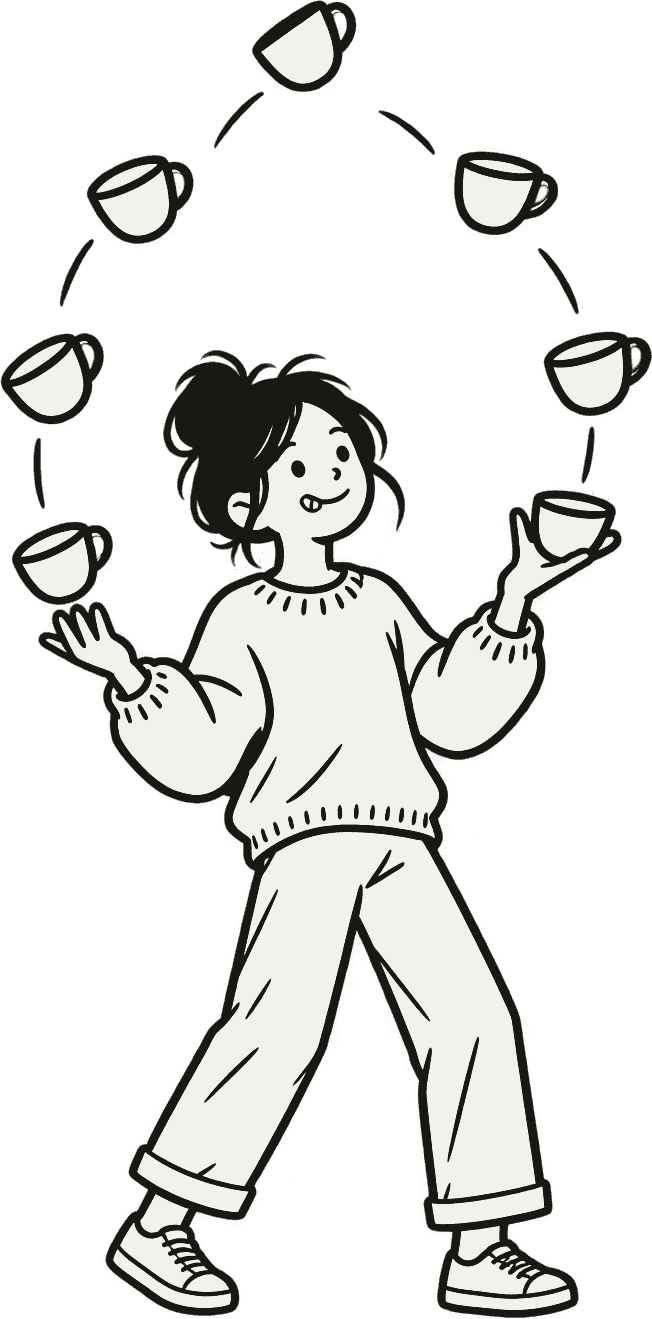
Think of it as juggling: work, a household, a phone full of people and at least one birthday you’re fairly sure is in winter. If a teacup or two has gone a little high, that isn’t a character flaw. It’s just a lot of teacups.
Am I a bad friend? The quiz
This ten-question quiz works out which kind of “bad” you are (there are five, and one of them is “genuinely great”) and gives you one small fix for this week. It’s a quiz, not a test, so nobody fails, and it doubles as an “am I a good friend?” quiz. Answer as the person you are in a normal week, not the one who exists for ten minutes after a really good night’s sleep.
Which kind of “bad friend” are you?
Ten questions, about two minutes. Pick the closest answer, even if two sound uncomfortably familiar.
Just for fun, not a diagnosis.
Nothing you tick leaves this page.
What each result means
The overbooked friend
Not a bad friend, a busy one. You care plenty; your week just has no gaps, and your friends are politely queued behind the washing. The fix this week: book ten minutes with one person the way you’d book a meeting, such as a call on the walk to the station. The long lunch can wait for “once things calm down”, a season that has yet to be scheduled.
How to stay in touch with friends when you’re busy →The low-battery friend
A good friend with a smaller tank, which is allowed. Big plans take something out of everyone, and you’re just honest about the bill. The fix this week: shrink one plan instead of skipping it, so dinner becomes a walk, or a call becomes a text with a photo of whatever made you think of them. A small yes is still a yes.
If replying is the hard part: bad at texting back →The seasonal friend
Warm, loyal and reliably annual, like the tinsel. The friendship is real; it just spends most of the year in a box in the hall cupboard. The fix this week: message one person you’d hate to lose, today, for no reason at all. Then pick a rhythm, so the next gap is a few months, not a whole year.
Why friendships drift apart, and how to stop it →Chair of the we-should-catch-up committee
All heart, no dates. Your intentions are excellent and extremely well documented; they just never make it into a calendar. The fix this week: whenever you type “we should catch up”, add a day and a place before you hit send. “Souvlaki, Wednesday, 6.30?” is a plan. “Soon” is not a day of the week.
Owe someone a reply first? How to apologise for not texting back →Genuinely great
You reach out, you turn up and you remember things. Taking a bad-friend quiz just to be sure is a very good-friend thing to do. If you still feel like the bad one, check whether you’re doing most of the reaching out, which is a different problem. The fix this week: carry on, and tell one friend something specific you like about them.
Always the one reaching out? One-sided friendship →Am I a bad friend for not reaching out?
Whether it’s not texting, not calling or never being the one to go first, the answer is usually no, and the worry itself is a clue. A 1994 review of research on guilt found it is strongest and most common in close relationships built on “mutual concern”, and that one of its jobs is getting people to treat each other well. Nobody lies awake feeling guilty about the real estate agent they haven’t called back.
The trouble is what that guilt can turn into. Research on moral emotions draws a useful line between shame, a verdict on “the global self”, and guilt, which is about one specific thing you did. Guilt tends to lead to repair, like apologising and making things right, while shame makes people want to hide.
“Am I a bad friend?” is a shame question, and there’s no good answer to it with the lights off. “I never asked Priya how the new flat is going” is a guilt one, and it comes with its own next step: ask about the flat.

Why the text gets harder to send the longer you leave it
Researchers who study procrastination point out that its costs are “typically borne by the future self”. With a neglected friend, the loop goes: feel bad, avoid the message, feel worse, avoid it harder. The text itself hasn’t grown. It’s still eleven words, but now it feels like it needs a run-up.
Forgiving yourself seems to help. In a small study of first-year university students, those who forgave themselves for procrastinating before one exam procrastinated less before the next (at least among those who had procrastinated most), largely because they felt less bad. It was about study, not friends, but its title, “I forgive myself, now I can study”, needs one word changed to become the whole plan.
For a whole system rather than one message, start with our guide on how to stay in touch with friends.
Why am I so bad at keeping in touch with friends?
Mostly because friendships are expensive and you’re on a fixed budget. Oxford psychologist Robin Dunbar’s 2018 review of the anatomy of friendship describes friendships as “extremely costly”, both in the time they take and in the brainpower behind them. It’s a capacity problem, not a character one.
In a 2020 review of how social networks work, Dunbar notes that “the time available for social interaction is severely limited”, so everyone makes trade-offs. Friendships also need more upkeep than family ties, which are more forgiving of “underinvestment”.
The same paper mentions primates that spend as much as a fifth of their day grooming each other. By comparison, the reply you owe Lorraine about her neighbour’s escaped chickens is practically a coffee break.
You’re not the only one short on time
In the Australian Bureau of Statistics’ 2024 time-use survey, balancing work and family was the most common reason people gave for always or often feeling rushed or pressed for time. Almost half of women aged 35 to 44 felt that way. Unhelpfully, that’s also peak season for 40th birthdays.
33%
Some people run on a smaller circle
Personality plays a part too: Dunbar’s review of human social networks notes that “extroverts have larger networks at all layer levels than introverts”. A smaller circle is a style, not a moral failing.
Being sociable may also have a delayed cost. In one small study of mood and fatigue that checked in with 48 people five times a day for 12 days, acting outgoing went with a better mood at the time and more fatigue at the check-in three hours later, whatever their personality.

So if you come home from a lovely wedding and need to sit very still for a while, you haven’t failed at friendship. The tired just tends to turn up a few hours after the fun.
If you have ADHD
If friends vanish from your mind the moment they’re out of sight, however much you love them, read our guide to ADHD object permanence and friendships.
When pulling back is a sign of something else
If you’ve pulled back from everyone, not just a friend or two, and it comes with feeling flat or guilty most of the time, that can be low mood rather than bad friendship. Beyond Blue lists withdrawing from close family and friends among the signs of depression, alongside feeling guilty, and says it’s worth talking to someone if that sounds familiar.
In Australia, you can call Beyond Blue on 1300 22 4636 or Lifeline on 13 11 14, both any time of day or night. Lifeline also takes texts on 0477 13 11 14. If life is in danger, call 000.
In the US, you can call or text the 988 Lifeline, and in the UK and Ireland Samaritans are on 116 123.
How to be a better friend this week (no makeover needed)
Being a better friend this week takes one message and a reminder, which is less cinematic than a makeover but far more likely to happen. Start with your quiz result’s fix, then take these five steps in order.
- Pick one person, not everyone. Start with the friend you’d most hate to lose. A short “thinking of you” is plenty, and the perfect paragraph can stay in your drafts, where it has lived happily since June.
- Answer what’s waiting first. If they asked you something, reply to that before you apologise for anything. Our guide on how to apologise for not texting back has the words.
- Be specific. Ask about the thing in their life you actually know about: the new job, the new flat, the trip to Japan.
- Attach a day. If you’d like to see them, suggest a real time and place. That’s the difference between a plan and a nice thought.
- Get the remembering out of your head. Decide roughly how often you’d like to hear from each person, then let a calendar, a list or an app do the reminding.
- I’ve owed you a proper message since your birthday, so here it is. How’s the new flat? Have the curtains turned up yet?
- I’ve been rubbish at keeping in touch and I miss you. Fish and chips on the beach next Saturday? I’ll handle the seagulls.
- There’s a man in Newtown who walks his cat on a lead, and you’re the only person who’d appreciate it. Did your neighbour ever get the chickens back?
Not sure if a quiet patch is drift or something bigger? Our guide to why friendships drift apart helps you tell, with a quick check of how long it’s been.
Just don’t turn friendship into a ledger. Robin Dunbar’s review of social networks notes that evolutionary studies of cooperation “tend to view relationships as a form of debt-logging”, then argues that close friends come to your aid “not because they owe you a favour” but out of “a sense of obligation and commitment”. Nobody wants to be invoiced for minding the cat.
Signs you’re actually being a bad friend
Here’s the honest part: the real signs are about trust and turning up, not texting. The ones worth taking seriously are not helping when they need it, sharing what they told you in confidence, putting them down in front of others and being jealous or critical of their other relationships.
In a classic 1984 study of the rules of friendship, researchers asked people in Britain, Italy, Hong Kong and Japan about 43 possible rules. When friendships ended, people blamed broken rules. Six rules that were rated very important also separated lapsed friendships from current ones, and they dealt mainly with “the exchange of rewards and intimacy”: help, support and trust.
The British participants’ top-rated rules, charted by Lapham’s Quarterly, read like a job description for a good mate, from volunteering help in time of need to standing up for them when they’re not there. Not one of the 18 highest-rated rules is about how often you get in touch.
Rule two, rated above trust: use their first name. We named an app Howdy Mate!, so we’ll be moving swiftly on.
So here’s the friendship crime sheet, sorted by penalty.
- Parking fines. Leaving a meme on read, forgetting to ask about the new flat, a quiet month. Pay by sending a message, then move on.
- A proper fine. Missing a birthday: annoying, human and fixable, because a late message still lands. Here are some belated birthday messages for a friend. (Missing their 40th after swearing you’d be there edges towards a court date.)
- Demerit points. Cancelling on the same person again and again, often at the last minute. Once is life, but a habit sends a message you don’t mean, so learn how to cancel plans with a friend politely and always offer a new date.
- A court date. Not turning up when they really needed you, sharing something they told you in confidence or putting them down in front of others. These are the ones that end friendships, and they need an honest conversation and a real apology, not a quiz result.
Notice where going quiet sits: with the parking fines, nowhere near the court dates. That doesn’t make it harmless. Dunbar notes that most friendships “die quietly as a result of reduced contact”, so drift is worth catching early, while one message can still restart things.
The guilt means you care. The text is how they find out.
The flip side: always the one reaching out?
If you took the quiz because you do all the reaching out and wondered whether you’re the problem, you’re probably not. Doing most of the starting isn’t the same as a one-sided friendship, and that guide helps you tell the difference.
The short version
- You’re probably not a bad friend. The worry shows the friendship matters to you.
- Swap the verdict for a name. “Am I a bad friend?” goes nowhere. “I haven’t replied to Priya” has a next step.
- It’s capacity, not character. Friendships cost time and attention, and plenty of us are short on both.
- Fix one thing this week. One specific message, one day attached and a rhythm so the gap stays closed.
- Know what actually hurts. Broken trust and not showing up can end a friendship outright. Going quiet lets it fade, so catch it early with one message.
Pick the teacup that’s highest in the air right now and message that person today. It doesn’t need to be clever or long. One caught teacup is plenty for today.
The short of it
- If you’re worried that you’re a bad friend, you’re most likely a good friend without a system, and the guilt itself is a sign the friendship matters to you.
- Asking “am I a bad friend?” judges your whole self, while “I haven’t replied to Priya” gives you one small thing you can fix today.
- Keeping in touch is hard because friendships cost time and attention, and a third of Australians say they always or often feel rushed or pressed for time.
- Broken trust and not showing up when it counts can end a friendship outright, while going quiet lets it fade, so it’s worth catching early with one specific message.
Questions people ask
Am I a bad friend for not reaching out?
Probably not. Going quiet for a while usually means you’re busy, tired or out of the habit, not that you don’t care. What tends to end friendships outright is broken trust and not being there when it matters. If it’s been a while, one short, specific message is the best place to start.
How do I know if I’m a bad friend?
Look at the things that tend to end friendships: not helping when they need it, sharing their secrets, criticising them in public or being jealous of their other relationships. If none of those sound like you, you’re probably a good friend who has fallen behind, and a message is the first step back.
Why do I always feel like a bad friend?
It may be that guilt about one thing has turned into shame, a verdict on your whole self. Shame tends to make people hide, which makes the gaps longer. Name one thing you can fix instead. If the feeling is constant and you’re pulling away from everyone, talk to someone, such as Beyond Blue on 1300 22 4636.
Why am I so bad at keeping in touch with people?
Mostly because friendships take time and attention, and both are limited. Research suggests friendships need more upkeep than family ties, and a third of Australians say they always or often feel rushed. It’s usually a capacity problem rather than a character one, and a simple system helps more than guilt.
Am I a bad friend for cancelling plans?
Not for cancelling once. Plans fall over for everyone, and telling them early with the real reason and a new date keeps it a one-off. It becomes a problem when cancelling turns into a pattern with the same person, because a habit sends a message even when you don’t mean it to.
Am I a bad friend for not wanting to hang out?
No. Wanting quiet time is normal, and socialising can be tiring even when you enjoy it. Tell your friend it’s about your energy, not them, and suggest something smaller, like a short walk or a call. If you’re avoiding everyone and feeling flat, it’s worth talking to someone.
Want a hand remembering? Howdy Mate! is free on the App Store.
Sources
- Guilt: an interpersonal approach. Psychological Bulletin (Baumeister, Stillwell and Heatherton), 1994.
- Moral emotions and moral behavior. Annual Review of Psychology (Tangney, Stuewig and Mashek), 2007.
- Procrastination and the priority of short-term mood regulation: consequences for future self. Social and Personality Psychology Compass (Sirois and Pychyl), 2013.
- I forgive myself, now I can study: how self-forgiveness for procrastinating can reduce future procrastination. Personality and Individual Differences (Wohl, Pychyl and Bennett), 2010.
- The anatomy of friendship. Trends in Cognitive Sciences (Dunbar), 2018.
- Structure and function in human and primate social networks: implications for diffusion, network stability and health. Proceedings of the Royal Society A (Dunbar), 2020.
- How Australians use their time, 2024. Australian Bureau of Statistics, 2025.
- Happy now, tired later? Extraverted and conscientious behavior are related to immediate mood gains, but to later fatigue. Journal of Personality (Leikas and Ilmarinen), 2017.
- Signs and symptoms of depression. Beyond Blue.
- Talk to a counsellor. Beyond Blue.
- Lifeline crisis support, 13 11 14. Lifeline Australia.
- 988 Suicide and Crisis Lifeline. 988 Lifeline.
- Contact a Samaritan. Samaritans.
- The rules of friendship. Journal of Social and Personal Relationships (Argyle and Henderson), 1984.
- Friend commandments. Lapham’s Quarterly.
Written by Sammy Sergi, who makes Howdy Mate!, a free iPhone app for keeping in touch with the people who matter. Every guide is checked against the research it cites.