Why men lose friends as they get older (and how to keep your mates)
Why do men lose friends as they get older? What the male friendship recession is, when the drop tends to start and low-cringe ways to keep your mates.
The short of it
- Men often lose friends as they get older because many of their friendships run on shared places and activities, so when school, sport or work ends, the contact can stop too.
- In a 2021 US survey, 27 per cent of men had six or more close friends, down from 55 per cent in 1990, though the two polls used different methods.
- Recent surveys find men don’t clearly have fewer friends than women, but they lean on friends less for support and keep in touch less between catch-ups.
- The low-cringe fix is a recurring plan, like a weekly pub night or an annual trip, plus a quick message between times and an honest one now and then.
Here’s why men lose friends as they get older, in short: men’s friendships tend to run on shared places and activities, like school, a team or work, and when those end, the contact often ends with them. On average, men are also less likely than women to fill the gap with calls and texts, so friendships lapse quietly.
Nobody falls out. A friendship can run for 20 years on the word “legend”, a thumbs-up and one footy-tipping comp, and then the comp folds.
A bloke will carry his mate’s fridge up three flights of stairs rather than say “I miss you”. Which is lovely, but people only move house so often.
Why do men lose friends as they get older?
Many men’s friendships are built side by side: the same class, the same team, the same worksite, the same Thursday at the same pub. The American Institute for Boys and Men found that when men connect, “it is often through group activities rather than one-on-one relationships”. Nobody has to organise anything; the place does it for you.
Then life moves one of you: the club merges with the one down the road, the job changes, someone has kids or moves to Darwin. Suddenly the friendship needs admin. (The general version is in why friendships drift apart; this is the men’s edition.)
Two things can make the drop steeper for men:
- Men keep in touch less between catch-ups. In Pew Research Center’s 2024 survey of 6,204 Americans, men with close friends messaged and called them less often than women did, though slightly more saw a close friend in person at least a few times a week (31 per cent against 28). So blokes do turn up. They just skip the text that makes turning up happen.
- Men lean on a partner. In a 2021 survey by the Survey Center on American Life, 85 per cent of married men said they turn to their spouse with a personal problem, against 72 per cent of married women. That works well, right up until the problem is the relationship.
All of this is on average. Plenty of men text their mates every day, and plenty of women don’t.
Nobody stopped caring. The season just ended.
Is it normal for a man to have no friends?
Yes, it’s more common than it feels. Depending on the survey, between about 1 in 10 and 1 in 5 men say they have no close friends: 9 per cent across four countries in a 2019 survey for Movember, and 20 per cent of American men in Pew’s 2024 survey (not counting family).
It often comes down to circumstances, not anything about who you are. In the same Movember survey, men who wanted more contact with close friends most often blamed distance (42 per cent), growing apart (36) or a lack of time (29). Our guide on why it’s so hard to make friends as an adult covers where to start again.
If it’s weighing on you, talk to someone. You don’t need to be in crisis to call.
- In Australia: MensLine Australia on 1300 78 99 78 (free, 24/7, by phone or online, for anything from stress to relationships), or Lifeline on 13 11 14 (or text 0477 13 11 14). If life is in danger, call 000.
- In the US and UK: call or text 988 in the US, or call Samaritans on 116 123 in the UK.
What age do men lose friends?
There’s no single age, but the number of people we keep in touch with tends to peak in the mid-20s. In 2007 phone records from 3.2 million people in one European country, the number of different people someone talked to each month, whoever rang whom, peaked at around 25 for both men and women.
Older age groups had fewer, and the fall was faster for men. It’s a snapshot of different people at different ages, and the calls include family, partners and work, so treat it as a rough map. Nothing expires at 25 except the young-driver fee on a hire car.
US time-use data charted by Our World in Data points the same way: American men average close to two hours a day with friends in person in their early 20s, and about half an hour by their early 40s.
At 30, it’s about four hours a day with co-workers and under one with friends. That’s a lot more Brendan-with-the-loud-keyboard than best mate, and Brendan, lovely as he is, was not a groomsman.
The reassuring part: what shrinks is mostly the outer circle. A small Californian study following adults aged 18 to 94 for ten years found losses “primarily in the number of peripheral partners”, while close partners stayed “relatively stable over time”. So if you’re 40 and wondering where everyone went, the best man and the bloke from the under-12s are probably still there, waiting for someone to organise something.
Why men lose friends in midlife
In midlife, work and family take the hours, people move and many men let a partner become their main confidant. In Movember’s 2019 survey of 4,000 men, 34 per cent of those aged 35 to 54 were very satisfied with their friendships, against 43 per cent of younger and older men.
- Kids. A fifth of fathers in the same survey said their number of close friends fell in the 12 months after becoming a dad. A newborn is a wonderful thing with no respect whatsoever for pub Thursday.
- The partner becomes the whole support team. Stanford researchers Angelica Ferrara and Dylan Vergara call the result “mankeeping”: the work women take on to “shore up losses in men’s social networks”. That’s a lot to put on one person: sounding board, cheer squad and the only one who remembers your mates’ kids’ names.
None of this means the friendships are gone. They’re more like the esky in the garage: perfectly good, just not taken anywhere lately. What they’ve lost is their hours, and hours are what friendships are made of (here’s how many hours it takes to make a friend).
What is the male friendship recession?
The male friendship recession describes a steep fall in men’s close friendships, measured mostly in US surveys. Daniel Cox, who ran the Survey Center on American Life’s 2021 survey, wrote that July: “This friendship recession is particularly bad for men.”
55% to 27%
Six close friends is a high bar, to be fair: that’s a five-a-side team with someone left over to hold the oranges. Over the same years, the share of men with no close friends rose from 3 to 15 per cent, while women’s circles shrank less steeply. The 1990 poll was by phone and the 2021 survey online, so treat the size of the drop as rough.
Is the male friendship recession real?
Partly: the drop shows up in that US series, but newer surveys find little gap between men and women. Pew’s 2024 survey found that “compared with women, men don’t report that they feel lonely more often or have fewer close friends”, and the American Institute for Boys and Men, a men-focused think tank, sees “much more of a class gap” than a gender gap in loneliness and isolation.
In Australia, men are more often socially isolated than women (18 per cent against 12 in 2024) but not lonelier. So whether it’s a recession depends on who’s doing the counting, which anyone who has ever run a tipping comp will recognise.
The surveys line up better on how men use their friends. In the Survey Center’s 2021 survey, 21 per cent of men had received emotional support from a friend in the past week, against 41 per cent of women, and 25 per cent had told a friend they loved them, against 49 per cent.

The rest, we suspect, said “legend”, which is the same sentiment at a lower volume. The count of friends is disputed. How men lean on them is far more consistent.
Why men’s friendships are different: doing, not talking
For men, doing more things together may matter more than talking more often. In one small study that followed 25 English school-leavers for 18 months, “relationship decline was prevented most by increased contact frequency (talking together) for females but by doing more activities together in the case of males”.
Keep it in proportion: 13 of the 25 were young men, all about 18, and the authors say whether it holds at other ages “needs further research”. The activities counted included “going to the pub”, and a holiday meant “going away for more than one night”. So an overnight fishing trip is, for research purposes, a holiday.
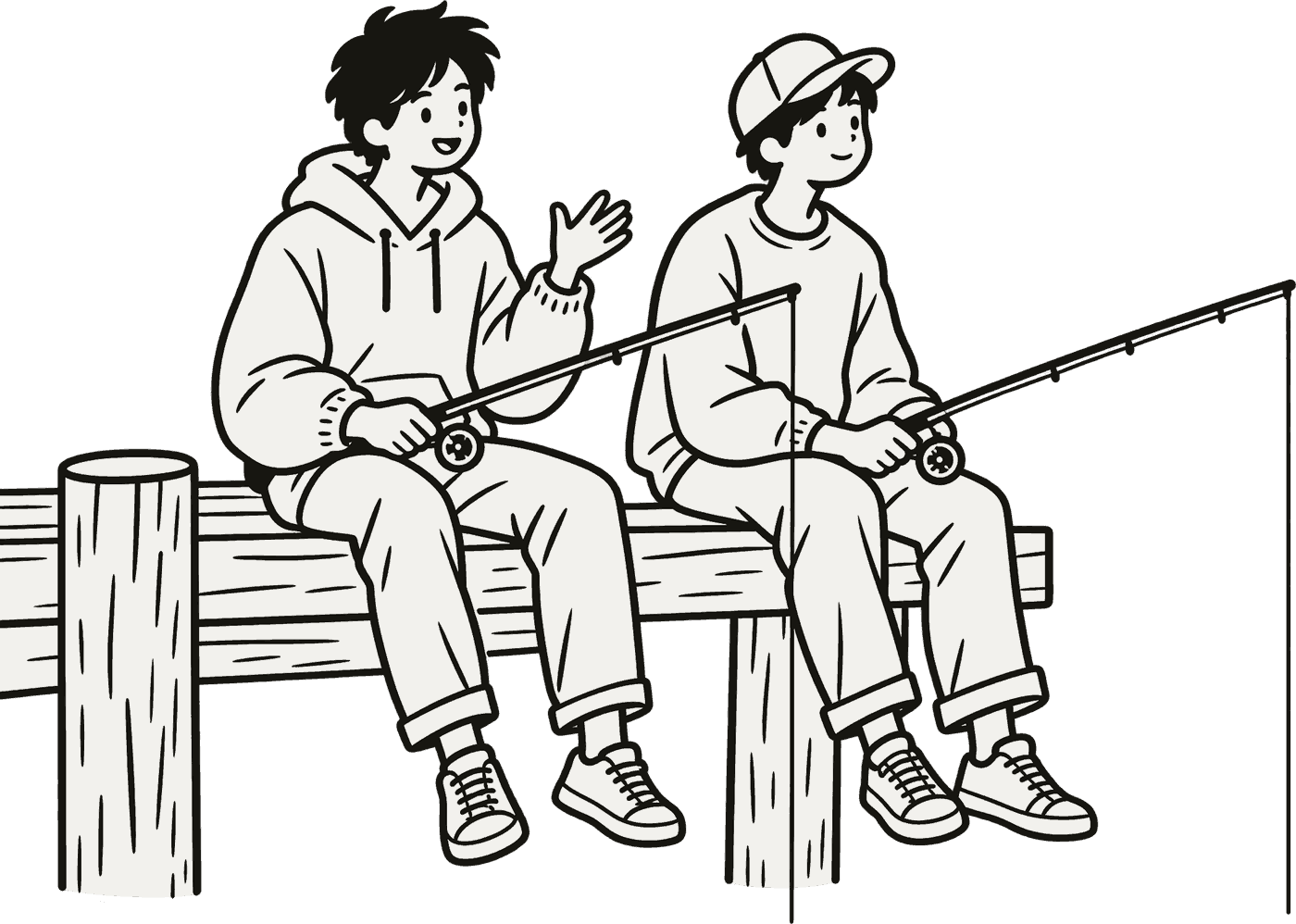
Australia turned this into infrastructure. The Men’s Shed motto, “Men don’t talk face to face, they talk shoulder to shoulder”, comes from Professor Barry Golding’s keynote at a 2007 conference, where it drew “unanimous mutterings of approval from all 350 delegates”.
Unanimous mutterings: bloke for “motion carried”.
Shoulder to shoulder has limits, though. The mankeeping paper argues that “shoulder-to-shoulder” activities and joking “are typically insufficient in meeting men’s social support needs”. So the plan keeps the friendship going, and every so often someone has to say something true.
Recurring plans that work:
- A weekly fixture. Pub Thursday, touch footy or parkrun (a free Saturday 5k you can walk, which suits a bad knee).
- A season-long thread. A footy-tipping comp gives eight blokes a reason to message each other every week for six months, mostly to complain.
- An annual trip. The fishing weekend or the away game. Lock in next year’s date before you pack the car.
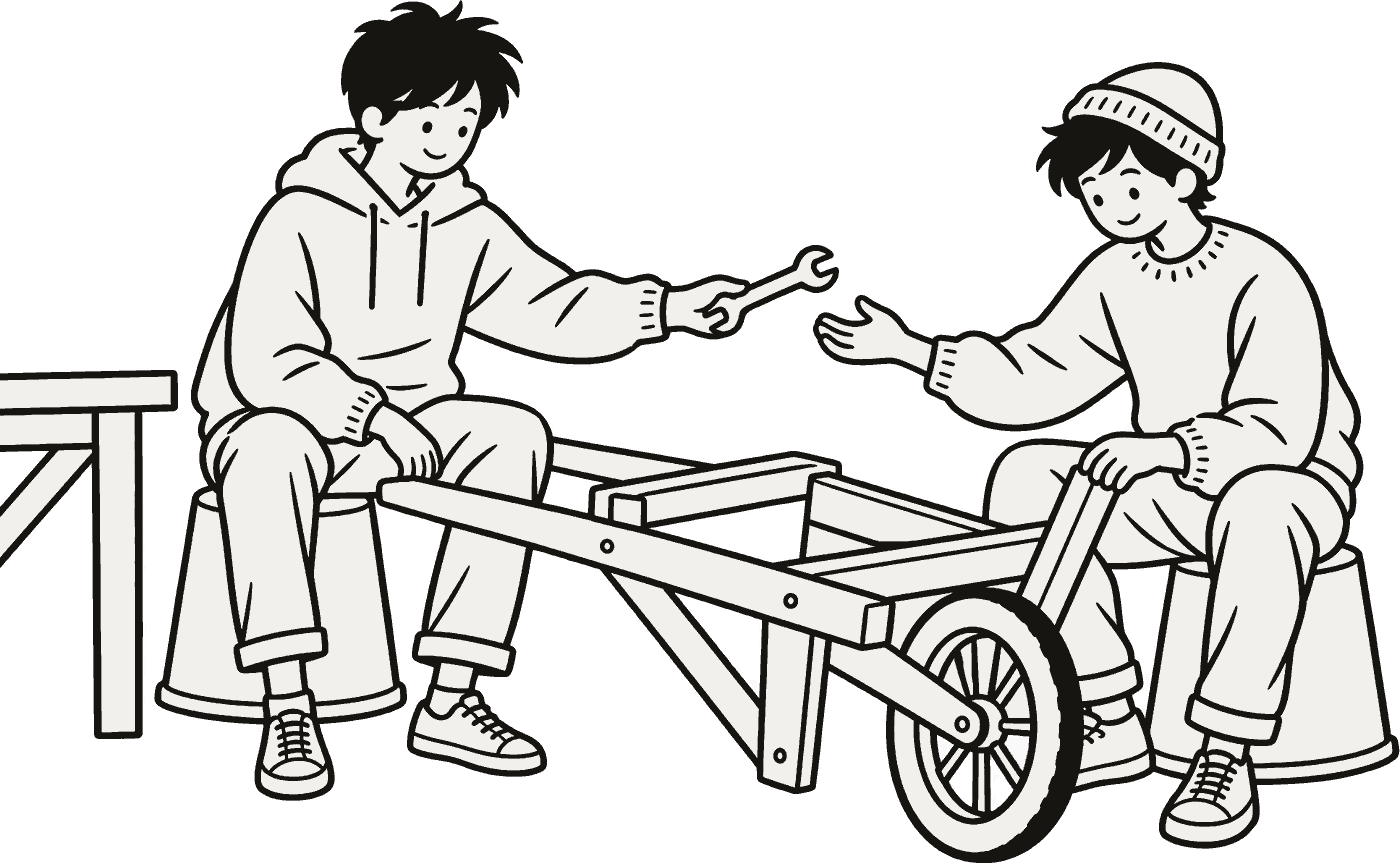
- A job. The deck, the ute, the billy cart. A job gives the silence something to do.
In Movember’s survey, about 1 in 5 Australian men asked about losing touch said they aren’t good at responding to friends or arranging to meet up. That is more or less the job description of a friendship app, which is handy, because we made one.
How do men keep friends? A low-cringe system
The low-cringe way for men to keep friends is to run the friendships like a footy club: a list of who’s in, a regular fixture and someone who sends the reminder. Most of it is one text long.
- Name the crew. The five to ten mates you’d hate to lose, including the one who still has your ladder.
- Give each a rhythm. Fortnightly for the footy crew, every month or two for the uni mates, a few times a year for the best man in Perth.
- Book a fixture. One recurring plan per crew. (For the asking part, see how to ask a friend to hang out.)
- Fill the gaps with small stuff. A photo of the fish, a kind word after his team loses. It all counts.
- Say one true thing now and then. Once or twice a year, then straight back to the fish.
- Restart with a plan, not a speech. “Been too long. Footy Sunday?” does the job, and nobody has to account for the last two years.
- Tipping comp is back. $20 in, winner picks the pub for the Grand Final. You in?
- Proposal: pub Thursday, 6pm, the Royal. Every week. Turn up when you can. No minutes will be taken.
- Same fishing weekend as last year? I’ll book the shack if you bring the esky.
For the wider habit, see how to stay in touch with friends.
How to reach out to a mate: the bloke text translator
Pick a level of sincerity, say one true thing and attach a plan. The plan makes it easy to answer; the true thing makes it land.
Don’t skip the true thing because it feels soppy. In a 2020 survey for Movember, eight in ten Australian men said they find it helpful when people ask if they’re having a difficult time, yet 52 per cent said no one had asked how they were coping during the pandemic.
Male sincerity comes in three strengths: Brave (“I’ve been thinking about you, and I value our friendship”), Normal (“Been too long, mate”) and Oi (“Oi, pub Thursday?”). All three mean exactly the same thing, so the translator’s rule is five words long: always end on a plan.
The bloke text translator
Every level ends in one. That’s the rule.
Oi. Haven’t seen you since your birthday. Unacceptable. Pub Thursday?
Every option
What you actually mean
When Sincerity level is “Oi.”
- Haven’t seen you since your birthday. Unacceptable.
- The crew hasn’t been in one room since Robbo’s 40th.
- You right? You’ve gone quiet.
When Sincerity level is “Hey mate.”
- It’s been way too long. I’ve been yelling at the footy on my own.
- Been missing the old crew lately. Reckon it’s reunion time.
- You’ve been a bit quiet lately. All good?
When Sincerity level is “Mate, bear with me, this is a soppy one.”
- I miss hanging out. Life got busy and I let it slide, and I don’t want to.
- I miss the old crew. Some of my best years were spent with you lot, and I want more of them.
- You’ve seemed a bit flat lately and I wanted to check in properly. How are you actually doing? I’m around, whatever the answer.
Oi is fine most weeks. Go Brave now and then, especially if a mate has gone quiet, and if he answers honestly, listen without rushing him. The charity R U OK?’s next steps are to encourage action (if he’s been really down for more than two weeks, gently suggest a health professional) and then to check in: “Pop a reminder in your diary to call them in a couple of weeks.”
Howdy Mate! has Schedule a Reminder under About on each mate’s page, which does the diary part: pick a date, and he’ll turn up on your Today screen on the day.
If something big has happened, like a death in the family, skip the translator and start with how to check in on a grieving friend. For other gaps, there are more openers in what to text a friend you haven’t talked to.
In November: ask how they’re really going

November is Movember, the month the Movember charity grows moustaches for men’s health, including mental health and suicide prevention. Their advice for a mate who seems off is short enough to remember on the way to the pub.
- Ask. “How are you really going?” Then ask again if the first answer is “yeah, good”.
- Listen. Don’t fix it, don’t top it with your own story. Let the silence sit.
- Encourage. If it sounds heavy, help him think about one small step, whether that’s a GP, a counsellor or another person he trusts.
- Check in again. A week later, without being asked. That second text is the one he’ll remember.
If you think a mate is in danger right now, call your local emergency number. Movember’s site lists support services by country.
The short version
- Why: many men’s friendships run on shared places and activities, and when those end, contact often does too.
- When: contact tends to peak in the mid-20s and thin through the 30s and 40s, mostly in the outer circle.
- The recession: US men with six or more close friends fell from 55 to 27 per cent, though whether men are worse off than women is disputed.
- What helps: a recurring plan, small stuff between times and one true thing now and then.
You never have to say “I miss you, mate”. “Oi, pub Thursday?” covers it most weeks. But if you ever do say it, you’ll find it weighs a lot less than a fridge, and he’ll carry it for years.
Questions people ask
Why do men lose friends as they get older?
Often because many men’s friendships are built around shared places and activities, such as school, sport and work, and when those end the contact can stop too. On average, men also keep in touch less between catch-ups and lean more on a partner for support.
What age do men start losing friends?
There’s no single age, but the number of people men keep in touch with tends to peak in the mid-20s. In 2007 phone records from one European country, the number of people someone talked to each month peaked around 25 and was lower at older ages, more so for men. US time-use data shows a similar drop into the 40s.
What is the male friendship recession?
It’s the name for a sharp drop in men’s close friendships in US survey data. In a 2021 Survey Center on American Life survey, 27 per cent of American men had six or more close friends, down from 55 per cent in 1990, though the two polls used different methods. Whether men are worse off than women is disputed.
What is mankeeping?
Mankeeping is a term from Stanford researchers Angelica Ferrara and Dylan Vergara for the work women do to shore up the gaps in men’s social networks, such as being a partner’s main or only confidant. It comes from their 2024 paper on the male friendship recession.
How do men keep their friendships going?
Doing things together seems to help most, such as a weekly pub night, a tipping comp, parkrun or an annual trip, plus a quick message between times. The evidence is thin: in one small study of English school-leavers, shared activities did more than contact frequency to protect young men’s friendships.
Want a hand remembering? Howdy Mate! is free on the App Store.
Sources
- Men’s social circles are shrinking. Survey Center on American Life, 2021.
- The state of American friendship: change, challenges, and loss. Survey Center on American Life, 2021.
- American men suffer a friendship recession. Survey Center on American Life, 2021.
- Men, women and social connections. Pew Research Center, 2025.
- Where men and women turn for emotional support and social connection. Pew Research Center, 2025.
- Men, women and social connections: topline. Pew Research Center, 2025.
- Global research report of male social connection: fatherhood and social connections. Movember and Ipsos MORI, 2019.
- Sex differences in social focus across the life cycle in humans. Royal Society Open Science, 2016.
- Who Americans spend their time with, by age. Our World in Data, from US Bureau of Labor Statistics data, 2025.
- Selective narrowing of social networks across adulthood is associated with improved emotional experience in daily life. International Journal of Behavioral Development, 2014.
- Theorizing mankeeping: the male friendship recession and women’s associated labor as a structural component of gender inequality. Psychology of Men and Masculinities, 2024.
- Male loneliness and isolation: what the data shows. American Institute for Boys and Men, 2025.
- Social isolation and loneliness. Australian Institute of Health and Welfare, 2026.
- Managing relationship decay: network, gender, and contextual effects. Human Nature, 2015.
- About AMSA. Australian Men’s Shed Association.
- parkrun Australia. parkrun.
- Over half of Australian men say no one has asked them how they are coping during COVID-19. Movember, 2020.
- How to ask R U OK?. R U OK?.
- MensLine Australia. MensLine Australia.
- Lifeline Australia. Lifeline.
- 988 Suicide and Crisis Lifeline. 988 Lifeline.
- Contact Samaritans. Samaritans.

Written by Sammy Sergi, who makes Howdy Mate!, a free iPhone app for keeping in touch with the people who matter. Every guide is checked against the research it cites.